|
Category: flavor and fragrance agents
US / EU / FDA / JECFA / FEMA / FLAVIS / Scholar / Patent Information:
Physical Properties:
Organoleptic Properties:
| |
| Odor Type: balsamic |
| |
| Odor Strength: | medium |
| |
| Substantivity: | 132 hour(s) at 100.00 % |
| |
| | sweet balsamic lily neroli labdanum amber |
Odor Description:
at 100.00 %. | sweet balsam lily neroli labdanum amber
Luebke, William tgsc, (1996) |
| |
| |
| Flavor Type: fruity |
| |
| | fruity tropical berry balsamic cinnamon spicy |
Taste Description:
| sweet fruity tropical berry balsamic cinnamon spicy
Luebke, William tgsc, (1996) |
| |
| Odor and/or flavor descriptions from others (if found). |
| |
| Givaudan |
| Linalyl Cinnamate |
| Odor Description: | Floral, Fruity, Balsamic, Sweet
Linalyl Cinnamate gives a sweet natural effect to floral, fruity and oriental compositions. It is ideal for use in delicate floral accords where it acts as a blending agent and as a fixative. |
| |
| Pell Wall Perfumes |
| Linalyl Cinnamate |
| Odor Description: | Floral-lily, Fruity, Balsamic, Sweet
Arctander tells us that “The fixative effect and the soft fruity-herbaceous undertones produced by this ester are often utilized in delicate floral bases such as Muguet, Lily, Freesia, etc.”
While Curtis & Williams describe it as a “superior fragrance-contributing fixative for Lily-of -the-Valley and other delicate florals” and suggest using it with citronellol and lilial for a muguet note. |
| |
| |
Cosmetic Information:
Suppliers:
| BOC Sciences |
| For experimental / research use only. |
| Linalyl Cinnamate
|
| Givaudan |
| Linalyl Cinnamate
Odor: Floral, Fruity, Balsamic, Sweet Use: Linalyl Cinnamate gives a sweet natural effect to floral, fruity and oriental compositions. It is ideal for use in delicate floral accords where it acts as a blending agent and as a fixative. |
| Lluch Essence |
| LINALYL CINNAMATE
|
| Pell Wall Perfumes |
| Linalyl Cinnamate
Odor: Floral-lily, Fruity, Balsamic, Sweet Use: Arctander tells us that “The fixative effect and the soft fruity-herbaceous undertones produced by this ester are often utilized in delicate floral bases such as Muguet, Lily, Freesia, etc.”
While Curtis & Williams describe it as a “superior fragrance-contributing fixative for Lily-of -the-Valley and other delicate florals” and suggest using it with citronellol and lilial for a muguet note. |
| Penta International |
| LINALYL CINNAMATE
|
| R C Treatt & Co Ltd |
| Linalyl Cinnamate
|
| Sigma-Aldrich: Aldrich |
| For experimental / research use only. |
| Linalyl Cinnamate
|
| Vigon International |
| Linalyl Cinnamate
Odor: Floral, Fruity, Balsamic, Sweet |
Safety Information:
| Preferred SDS: View |
| European information : |
| Most important hazard(s): | | None - None found. |
S 02 - Keep out of the reach of children.
S 24/25 - Avoid contact with skin and eyes.
|
| |
| Hazards identification |
| |
| Classification of the substance or mixture |
| GHS Classification in accordance with 29 CFR 1910 (OSHA HCS) |
| None found. |
| GHS Label elements, including precautionary statements |
| |
| Pictogram | |
| |
| Hazard statement(s) |
| None found. |
| Precautionary statement(s) |
| None found. |
| Human Experience: |
| 8 % solution: no irritation or sensitization. |
| Oral/Parenteral Toxicity: |
gavage-rat LD50 [sex: M,F] 9960 mg/kg
Published study. Confidence limits of 8230-12050 mg/kg bw, groups of 5 M and 5 F.
(Jenner et al., 1964)
oral-rat LD50 9960 mg/kg
Food and Cosmetics Toxicology. Vol. 14, Pg. 463, 1976.
|
| Dermal Toxicity: |
skin-rabbit LD50 > 5000 mg/kg
Food and Cosmetics Toxicology. Vol. 14, Pg. 463, 1976.
|
| Inhalation Toxicity: |
|
Not determined
|
Safety in Use Information:
| Category: | flavor and fragrance agents |
| RIFM Fragrance Material Safety Assessment: Search |
| IFRA Code of Practice Notification of the 49th Amendment to the IFRA Code of Practice |
| maximum skin levels for fine fragrances: | | | 0.4200 % and are based on the assumption that the fragrance mixture is used at 20% in a consumer product (IFRA Use Level Survey). (IFRA, 2002)
|
| Recommendation for linalyl cinnamate usage levels up to: | | | 8.0000 % in the fragrance concentrate.
|
| use level in formulae for use in cosmetics: | | | 1.0500 %
|
| Dermal Systemic Exposure in Cosmetic Products: | | | 0.0268 mg/kg/day (IFRA, 2002)
|
| |
| Maximised Survey-derived Daily Intakes (MSDI-EU): | 6.00 (μg/capita/day) |
| Maximised Survey-derived Daily Intakes (MSDI-USA): | 3.00 (μg/capita/day) |
| Structure Class: | I |
| Use levels for FEMA GRAS flavoring substances on which the FEMA Expert Panel based its judgments that the substances are generally recognized as safe (GRAS). |
| The Expert Panel also publishes separate extensive reviews of scientific information on all FEMA GRAS flavoring substances and can be found at FEMA Flavor Ingredient Library |
| publication number: 3 |
| Click here to view publication 3 |
| | average usual ppm | average maximum ppm |
| baked goods: | - | 2.10000 |
| beverages(nonalcoholic): | - | 0.57000 |
| beverages(alcoholic): | - | - |
| breakfast cereal: | - | - |
| cheese: | - | - |
| chewing gum: | - | - |
| condiments / relishes: | - | - |
| confectionery froastings: | - | - |
| egg products: | - | - |
| fats / oils: | - | - |
| fish products: | - | - |
| frozen dairy: | - | 0.59000 |
| fruit ices: | - | 0.59000 |
| gelatins / puddings: | - | - |
| granulated sugar: | - | - |
| gravies: | - | - |
| hard candy: | - | 2.00000 |
| imitation dairy: | - | - |
| instant coffee / tea: | - | - |
| jams / jellies: | - | - |
| meat products: | - | - |
| milk products: | - | - |
| nut products: | - | - |
| other grains: | - | - |
| poultry: | - | - |
| processed fruits: | - | - |
| processed vegetables: | - | - |
| reconstituted vegetables: | - | - |
| seasonings / flavors: | - | - |
| snack foods: | - | - |
| soft candy: | - | - |
| soups: | - | - |
| sugar substitutes: | - | - |
| sweet sauces: | - | - |
Safety References:
| Flavor & Extract Manufacturers Association (FEMA) reference(s): |
| The FEMA GRAS assessment of cinnamyl derivatives used as flavor ingredients. View pdf |
| European Food Safety Athority(EFSA): | Flavor usage levels; Subacute, Subchronic, Chronic and Carcinogenicity Studies; Developmental / Reproductive Toxicity Studies; Genotoxicity Studies... |
| European Food Safety Authority (EFSA) reference(s): |
Opinion of the Scientific Panel on food additives, flavourings, processing aids and materials in contact with food (AFC) related to Flavouring Group Evaluation 15 (FGE.15): Aryl-substituted saturated and unsaturated primary alcohol/aldehyde/acid/ester derivatives from chemical group 22 (Commission Regulation (EC) No 1565/2000 of 18 July 2000)
View page or View pdf |
Flavouring Group Evaluation 15, Revision 1 (FGE.15Rev1) - Aryl-substituted saturated and unsaturated primary alcohol/aldehyde/acid/ester derivatives from chemical group 22 - Opinion of the Scientific Panel on Food Additives, Flavourings, Processing Aids and Materials in contact with Food (AFC)
View page or View pdf |
Scientific Opinion on Flavouring Group Evaluation 68 (FGE.68): Consideration of cinnamyl alcohol and related flavouring agents evaluated by JECFA (55th meeting) evaluated by EFSA in FGE.15Rev1 (2008)
View page or View pdf |
| EPI System: | View |
| EPA Substance Registry Services (TSCA): | 78-37-5 |
| EPA ACToR: | Toxicology Data |
| EPA Substance Registry Services (SRS): | Registry |
| Laboratory Chemical Safety Summary : | 5355858 |
| National Institute of Allergy and Infectious Diseases: | Data |
| WGK Germany: | 2 |
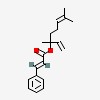
| | 3,7-dimethylocta-1,6-dien-3-yl (E)-3-phenylprop-2-enoate |
| Chemidplus: | 0000078375 |
References:
| | 3,7-dimethylocta-1,6-dien-3-yl (E)-3-phenylprop-2-enoate |
| NIST Chemistry WebBook: | Search Inchi |
| Canada Domestic Sub. List: | 78-37-5 |
| Pubchem (cid): | 5355858 |
| Pubchem (sid): | 134970755 |
Other Information:
Potential Blenders and core components notePotential Uses:
Occurrence (nature, food, other): noteSynonyms:
| | cinnamic acid 1,5-dimethyl-1-vinyl-4-hexen-1-yl ester | | | cinnamic acid 1,5-dimethyl-1-vinyl-4-hexenyl ester | | | cinnamic acid linalyl ester | | | cinnamic acid, 1, 5-dimethyl-1-vinyl-4-hexenyl ester | | | cinnamic acid, 1,5-dimethyl-1-vinyl-4-hexen-1-yl ester | | | cinnamic acid, 1,5-dimethyl-1-vinyl-4-hexenyl ester | | | cinnamic acid, linalyl ester | | 1,5- | dimethyl-1-vinyl hex-4-enyl 3-phenyl-2-propenoate | | 1,5- | dimethyl-1-vinyl-4-hexen-1-yl cinnamate | | 1,5- | dimethyl-1-vinyl-4-hexenyl cinnamate | | 3,7- | dimethyl-1,6-octadien-3-yl 3-phenyl propenoate | | 3,7- | dimethyl-1,6-octadien-3-yl 3-phenylpropenoate | | 3,7- | dimethyl-1,6-octadien-3-yl beta-phenyl acrylate | | 3,7- | dimethyl-1,6-octadien-3-yl cinnamate | | 3,7- | dimethyl-1,6-octadien-3-yl cinnamtae | | 3,7- | dimethylocta-1,6-dien-3-yl (E)-3-phenylprop-2-enoate | | 1- | ethenyl-1,5-dimethyl-4-hexenyl 3-phenyl-2-propenoate | | 4- | hexen-1-ol, 1,5-dimethyl-1-vinyl-, cinnamate | | | linalyl 3-phenyl propenoate | | | linalyl 3-phenylpropenoate | | 1,6- | octadien-3-ol, 3,7-dimethyl-, cinnamate | | 3- | phenyl-2-propenoic acid 1-ethenyl-1,5-dimethyl-4-hexenyl ester | | 3- | phenyl-2-propenoic acid, 1,5-dimethyl-1-vinyl-4-hexen-1-yl ester | | 2- | propenoic acid, 3-phenyl-, 1-ethenyl-1,5-dimethyl-4-hexenyl ester | | 2- | propenoic acid, 3-phenyl-, 1,5-dimethyl-1-vinyl-4-hexen-1-yl ester |
Articles:
|






 3D/inchi