|
Category: herbicides / pesticides
US / EU / FDA / JECFA / FEMA / FLAVIS / Scholar / Patent Information:
Physical Properties:
| Appearance: | white powder (est) |
| Assay: | 95.00 to 100.00 %
|
| Food Chemicals Codex Listed: | No |
| Boiling Point: | 457.90 °C. @ 760.00 mm Hg (est)
|
| Flash Point: | 447.00 °F. TCC ( 230.70 °C. ) (est)
|
| logP (o/w): | 4.020 (est) |
| Soluble in: |
| | water, 11.99 mg/L @ 25 °C (est) |
Organoleptic Properties:
| |
| Odor and/or flavor descriptions from others (if found). |
| |
| |
Cosmetic Information:
Suppliers:
Safety Information:
| Preferred SDS: View |
| |
| Hazards identification |
| |
| Classification of the substance or mixture |
| GHS Classification in accordance with 29 CFR 1910 (OSHA HCS) |
| None found. |
| GHS Label elements, including precautionary statements |
| |
| Pictogram | |
| |
| Hazard statement(s) |
| None found. |
| Precautionary statement(s) |
| None found. |
| Oral/Parenteral Toxicity: |
|
Not determined
|
| Dermal Toxicity: |
|
Not determined
|
| Inhalation Toxicity: |
|
Not determined
|
Safety in Use Information:
| Category: | herbicides / pesticides |
| Recommendation for fenhexamid usage levels up to: | | | not for fragrance use.
|
| |
| Recommendation for fenhexamid flavor usage levels up to: |
| | not for flavor use.
|
Safety References:
| European Food Safety Authority (EFSA) reference(s): |
Reasoned opinion on the review of the existing maximum residue levels (MRLs) for fenhexamid according to Article 12 of Regulation (EC) No 396/2005
View page or View pdf |
Conclusion on the peer review of the pesticide risk assessment of the active substance fenhexamid
View page or View pdf |
Reasoned opinion on the modification of the MRLs for fenhexamid in various berries
View page or View pdf |
Modification of the existing maximum residue levels for fenhexamid in various crops
View page or View pdf |
| EPI System: | View |
| Cancer Citations: | Search |
| Toxicology Citations: | Search |
| EPA ACToR: | Toxicology Data |
| EPA Substance Registry Services (SRS): | Registry |
| Laboratory Chemical Safety Summary : | 213031 |
| National Institute of Allergy and Infectious Diseases: | Data |
| WGK Germany: | 2 |
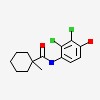
| | N-(2,3-dichloro-4-hydroxyphenyl)-1-methylcyclohexane-1-carboxamide |
| Chemidplus: | 0126833178 |
| RTECS: | GU7879550 for cas# 126833-17-8 |
References:
| | N-(2,3-dichloro-4-hydroxyphenyl)-1-methylcyclohexane-1-carboxamide |
| NIST Chemistry WebBook: | Search Inchi |
| Pubchem (cid): | 213031 |
| Pubchem (sid): | 135187461 |
Other Information:
Potential Blenders and core components notePotential Uses:
Occurrence (nature, food, other): noteSynonyms:
| | cyclohexanecarboxamide, N-(2,3-dichloro-4-hydroxyphenyl)-1-methyl- | | N-(2,3- | dichloro-4-hydroxyphenyl)-1-methylcyclohexane-1-carboxamide | | | KBR-2738 | | | KBR2738 |
Articles:
| PubMed: | Fungicide resistance of Botrytis cinerea in tomato greenhouses in the Canary Islands and effectiveness of non-chemical treatments against gray mold. |
| PubMed: | Genetic diversity in Monilinia laxa populations in stone fruit species in Hungary. |
| PubMed: | Morphological and phylogenetic identification of Botrytis sinoviticola, a novel cryptic species causing gray mold disease of table grapes (Vitis vinifera) in China. |
| PubMed: | Occurrence of fungicide resistance in populations of Botryotinia fuckeliana (Botrytis cinerea) on table grape and strawberry in southern Italy. |
| PubMed: | Influence of new generation fungicides on Saccharomyces cerevisiae growth, grape must fermentation and aroma biosynthesis. |
| PubMed: | Metabolomic approach assisted high resolution LC-ESI-MS based identification of a xenobiotic derivative of fenhexamid produced by Lactobacillus casei. |
| PubMed: | Toxic responses and antioxidative enzymes activity of Scenedesmus obliquus exposed to fenhexamid and atrazine, alone and in mixture. |
| PubMed: | Effect of nonpersistent pesticides on estrogen receptor, androgen receptor, and aryl hydrocarbon receptor. |
| PubMed: | Assessment of silicone as support to investigate the transformation routes of organic chemicals under environmental conditions and UV exposure. Application to selected fungicides. |
| PubMed: | Liquid chromatography time-of-flight mass spectrometry evaluation of fungicides reactivity in free chlorine containing water samples. |
| PubMed: | A functional bikaverin biosynthesis gene cluster in rare strains of Botrytis cinerea is positively controlled by VELVET. |
| PubMed: | Role of sterol 3-ketoreductase sensitivity in susceptibility to the fungicide fenhexamid in Botrytis cinerea and other phytopathogenic fungi. |
| PubMed: | Endocrine disruptors fludioxonil and fenhexamid stimulate miR-21 expression in breast cancer cells. |
| PubMed: | Competitive androgen receptor antagonism as a factor determining the predictability of cumulative antiandrogenic effects of widely used pesticides. |
| PubMed: | Retrospective screening of relevant pesticide metabolites in food using liquid chromatography high resolution mass spectrometry and accurate-mass databases of parent molecules and diagnostic fragment ions. |
| PubMed: | Biological activity of the succinate dehydrogenase inhibitor fluopyram against Botrytis cinerea and fungal baseline sensitivity. |
| PubMed: | The allele-specific probe and primer amplification assay, a new real-time PCR method for fine quantification of single-nucleotide polymorphisms in pooled DNA. |
| PubMed: | Genetic diversity of a Botrytis cinerea cryptic species complex in Hungary. |
| PubMed: | Determination of famoxadone, fenamidone, fenhexamid and iprodione residues in greenhouse tomatoes. |
| PubMed: | Strong resistance to the fungicide fenhexamid entails a fitness cost in Botrytis cinerea, as shown by comparisons of isogenic strains. |
| PubMed: | Remediation of fungicide residues on fresh produce by use of gaseous ozone. |
| PubMed: | Use of soft and hard ionization techniques for elucidation of unknown compounds by gas chromatography/time-of-flight mass spectrometry. |
| PubMed: | The sterol biosynthesis inhibitor molecule fenhexamid impacts the vegetative compatibility of Glomus clarum. |
| PubMed: | Glove accumulation of pesticide residues for strawberry harvester exposure assessment. |
| PubMed: | Widely used pesticides with previously unknown endocrine activity revealed as in vitro antiandrogens. |
| PubMed: | Photocatalytic degradation of the fungicide Fenhexamid in aqueous TiO(2) suspensions: identification of intermediates products and reaction pathways. |
| PubMed: | Fenpropimorph and fenhexamid impact phosphorus translocation by arbuscular mycorrhizal fungi. |
| PubMed: | Photochemical analysis of 14C-fenhexamid in aqueous solution and structural elucidation of a new metabolite. |
| PubMed: | Multiple resistance of Botrytis cinerea from kiwifruit to SDHIs, QoIs and fungicides of other chemical groups. |
| PubMed: | Influence of several fungicides on the antioxidant activity of red wines (var. Monastrell). |
| PubMed: | Multi-residue analysis of 30 currently used pesticides in fine airborne particulate matter (PM 2.5) by microwave-assisted extraction and liquid chromatography-tandem mass spectrometry. |
| PubMed: | Chemometric study and optimization of extraction parameters in single-drop microextraction for the determination of multiclass pesticide residues in grapes and apples by gas chromatography mass spectrometry. |
| PubMed: | Arbuscular mycorrhiza partially protect chicory roots against oxidative stress induced by two fungicides, fenpropimorph and fenhexamid. |
| PubMed: | Monoclonal antibody generation and direct competitive enzyme-linked immunosorbent assay evaluation for the analysis of the fungicide fenhexamid in must and wine. |
| PubMed: | Multiresidue pesticide analysis of wines by dispersive solid-phase extraction and ultrahigh-performance liquid chromatography-tandem mass spectrometry. |
| PubMed: | Effectiveness of control strategies against Botrytis cinerea in vineyard and evaluation of the residual fungicide concentrations. |
| PubMed: | Removal of fenhexamid and pyrimethanil from aqueous solutions by clays and organoclays. |
| PubMed: | Differential effects of fenpropimorph and fenhexamid, two sterol biosynthesis inhibitor fungicides, on arbuscular mycorrhizal development and sterol metabolism in carrot roots. |
| PubMed: | Botryticides affect grapevine leaf photosynthesis without inducing defense mechanisms. |
| PubMed: | Fenhexamid adsorption behavior on soil amended with wine lees. |
| PubMed: | Toxicity of six novel fungicides and sulphur to Galendromus occidentalis (Acari: Phytoseiidae). |
| PubMed: | Genetic analysis of fenhexamid-resistant field isolates of the phytopathogenic fungus Botrytis cinerea. |
| PubMed: | Effect of the use of recent commercial fungicides [under good and critical agricultural practices] on the aroma composition of Monastrell red wines. |
| PubMed: | Influence of fungicides on grape yeast content and its evolution in the fermentation. |
| PubMed: | Effects of two sterol biosynthesis inhibitor fungicides (fenpropimorph and fenhexamid) on the development of an arbuscular mycorrhizal fungus. |
| PubMed: | Behavior of fenhexamid in soil and water. |
| PubMed: | Evaluation of solid sorbents for the determination of fenhexamid, metalaxyl-M, pyrimethanil, malathion and myclobutanil residues in air samples: application to monitoring malathion and fenhexamid dissipation in greenhouse air using C-18 or Supelpak-2 for sampling. |
| PubMed: | Disappearance of fenhexamid residues during wine-making process. |
| PubMed: | Impact of fungicides on Aspergillus carbonarius growth and ochratoxin A production on synthetic grape-like medium and on grapes. |
| PubMed: | Rapid gas chromatographic method for the determination of famoxadone, trifloxystrobin and fenhexamid residues in tomato, grape and wine samples. |
| PubMed: | Determination of fungicide residues in field-grown strawberries following different fungicide strategies against gray mold (Botrytis cinerea). |
| PubMed: | Residues of azoxystrobin, fenhexamid and pyrimethanil in strawberry following field treatments and the effect of domestic washing. |
| PubMed: | Metallothionein induction, antioxidative responses, glycogen and growth changes in Tubifex tubifex (Oligochaete) exposed to the fungicide, fenhexamid. |
| PubMed: | Behavior of a fenhexamid photoproduct during the alcoholic fermentation of Saccharomyces cerevisiae. |
| PubMed: | Activity of some chemicals in the control of Botrytis cinerea on roses. |
| PubMed: | Application of liquid chromatography with electrospray tandem mass spectrometry to the determination of a new generation of pesticides in processed fruits and vegetables. |
| PubMed: | Analysis of fenhexamid in caneberry, blueberry, and pomegranate by liquid chromatography-tandem mass spectrometry. |
| PubMed: | Processing factors and variability of pyrimethanil, fenhexamid and tolylfluanid in strawberries. |
| PubMed: | Interaction between fenhexamid and yeasts during the alcoholic fermentation of Saccharomyces cerevisiae. |
| PubMed: | Characterization of Bc-hch, the Botrytis cinerea homolog of the Neurospora crassahet-c vegetative incompatibility locus, and its use as a population marker. |
| PubMed: | Mechanisms of resistance to fungicides in field strains of Botrytis cinerea. |
| PubMed: | The hydroxyanilide fenhexamid, a new sterol biosynthesis inhibitor fungicide efficient against the plant pathogenic fungus Botryotinia fuckeliana (Botrytis cinerea). |
| PubMed: | Fenhexamid residues in grapes and wine. |
|
 3D/inchi