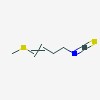
4-(methyl thio)-3-butenyl isothiocyanate
raphasatin
 
Notes:
None found
Synonyms   Articles   Notes   Search
CAS Number: 51598-96-0Picture of molecule3D/inchi
FDA UNII: Search
XlogP3-AA: 2.90 (est)
Molecular Weight: 159.27473000
Formula: C6 H9 N S2
NMR Predictor: Predict (works with chrome, Edge or firefox)
Category: natural substances and extractives
 
US / EU / FDA / JECFA / FEMA / FLAVIS / Scholar / Patent Information:
Google Scholar: Search
Google Books: Search
Google Scholar: with word "volatile"Search
Google Scholar: with word "flavor"Search
Google Scholar: with word "odor"Search
Google Patents: Search
US Patents: Search
EU Patents: Search
Pubchem Patents: Search
PubMed: Search
NCBI: Search
Synonyms   Articles   Notes   Search   Top
Physical Properties:
Assay: 95.00 to 100.00 % 
Food Chemicals Codex Listed: No
Soluble in:
 water, 208.9 mg/L @ 25 °C (est)
Synonyms   Articles   Notes   Search   Top
Organoleptic Properties:
 
Odor and/or flavor descriptions from others (if found).
 
 
Synonyms   Articles   Notes   Search   Top
Cosmetic Information:
None found
Synonyms   Articles   Notes   Search   Top
Suppliers:
 None found
Synonyms   Articles   Notes   Search   Top
Safety Information:
 
Hazards identification
 
Classification of the substance or mixture
GHS Classification in accordance with 29 CFR 1910 (OSHA HCS)
None found.
GHS Label elements, including precautionary statements
 
Pictogram
 
Hazard statement(s)
None found.
Precautionary statement(s)
None found.
Oral/Parenteral Toxicity:
Not determined
Dermal Toxicity:
Not determined
Inhalation Toxicity:
Not determined
Synonyms   Articles   Notes   Search   Top
Safety in Use Information:
Category: natural substances and extractives
Recommendation for 4-(methyl thio)-3-butenyl isothiocyanate usage levels up to:
 not for fragrance use.
 
Recommendation for 4-(methyl thio)-3-butenyl isothiocyanate flavor usage levels up to:
 not for flavor use.
Synonyms   Articles   Notes   Search   Top
Safety References:
EPI System: View
AIDS Citations: Search
Cancer Citations: Search
Toxicology Citations: Search
EPA ACToR: Toxicology Data
EPA Substance Registry Services (SRS): Registry
Laboratory Chemical Safety Summary : 103500
National Institute of Allergy and Infectious Diseases: Data
 4-isothiocyanato-1-methylsulfanylbut-1-ene
Chemidplus: 0051598960
Synonyms   Articles   Notes   Search   Top
References:
 4-isothiocyanato-1-methylsulfanylbut-1-ene
NIST Chemistry WebBook: Search Inchi
Pubchem (cid): 103500
Pubchem (cas): 51598-96-0
Synonyms   Articles   Notes   Search   Top
Other Information:
(IUPAC): Atomic Weights of the Elements 2011 (pdf)
Videos: The Periodic Table of Videos
tgsc: Atomic Weights use for this web site
(IUPAC): Periodic Table of the Elements
HMDB (The Human Metabolome Database): Search
VCF-Online: VCF Volatile Compounds in Food
ChemSpider: View
Synonyms   Articles   Notes   Search   Top
Potential Blenders and core components note
 
None Found
 
Synonyms   Articles   Notes   Search   Top
Potential Uses:
None Found
Synonyms   Articles   Notes   Search   Top
Occurrence (nature, food, other): note
 radish leaf
Search Trop  Picture
 radish root
Search Trop  Picture
Synonyms   Articles   Notes   Search   Top
Synonyms:
1-butene, 4-isothiocyanato-1-(methylthio)-
4-(methylthio)-3-butenyl isothiocyanate
 raphasatin
4-isothiocyanato-1-(methylthio)-1-butene
4-isothiocyanato-1-methylsulfanylbut-1-ene
Synonyms   Articles   Notes   Search   Top
Articles:
PubMed: 4-Methylthio-3-butenyl isothiocyanate (raphasatin) exerts chemopreventive effects against esophageal carcinogenesis in rats.
PubMed: Toxic effects of 4-methylthio-3-butenyl isothiocyanate (Raphasatin) in the rat urinary bladder without genotoxicity.
PubMed: The effect of radish sourced 4-(Methylthio)-3-butenyl isothiocyanate on ameliorating the severity of high fat diet inducted nonalcoholic fatty liver disease in rats.
PubMed: Generation of the antioxidant yellow pigment derived from 4-methylthio-3-butenyl isothiocyanate in salted radish roots (takuan-zuke).
PubMed: Vitexin-2-O-xyloside, raphasatin and (-)-epigallocatechin-3-gallate synergistically affect cell growth and apoptosis of colon cancer cells.
PubMed: Chemopreventive effects of 4-methylthio-3-butenyl Isothiocyanate (Raphasatin) but not curcumin against pancreatic carcinogenesis in hamsters.
PubMed: The MAPK pathway signals telomerase modulation in response to isothiocyanate-induced DNA damage of human liver cancer cells.
PubMed: Low concentrations of isothiocyanates protect mesenchymal stem cells from oxidative injuries, while high concentrations exacerbate DNA damage.
PubMed: Raphasatin is a more potent inducer of the detoxification enzymes than its degradation products.
PubMed: Hexane extract of Raphanus sativus L. roots inhibits cell proliferation and induces apoptosis in human cancer cells by modulating genes related to apoptotic pathway.
PubMed: In-vitro free radical scavenging, antiproliferative and anti-zearalenone cytotoxic effects of 4-(methylthio)-3-butenyl isothiocyanate from Tunisian Raphanus sativus.
PubMed: Mustard oil in "Shibori Daikon" a variety of Japanese radish, selectively inhibits the proliferation of H-ras-transformed 3Y1 cells.
PubMed: Isothiocyanate from the Tunisian radish (Raphanus sativus) prevents genotoxicity of Zearalenone in vivo and in vitro.
PubMed: Potential skin antiinflammatory effects of 4-methylthiobutylisothiocyanate (MTBI) isolated from rocket (Eruca sativa) seeds.
PubMed: Isothiocyanate profile and selective antibacterial activity of root, stem, and leaf extracts derived from Raphanus sativus L.
PubMed: Kaiware Daikon (Raphanus sativus L.) extract: a naturally multipotent chemopreventive agent.
PubMed: Comparison of the glucosinolate-myrosinase systems among daikon (Raphanus sativus, Japanese white radish) varieties.
PubMed: Cytotoxic and antioxidant activity of 4-methylthio-3-butenyl isothiocyanate from Raphanus sativus L. (Kaiware Daikon) sprouts.
PubMed: Aqueous extract from Spanish black radish (Raphanus sativus L. Var. niger) induces detoxification enzymes in the HepG2 human hepatoma cell line.
PubMed: A major factor in gravitropism in radish hypocotyls is the suppression of growth on the upper side of hypocotyls.
PubMed: Raphanus sativus and its isothiocyanates inhibit vascular smooth muscle cells proliferation and induce G(1) cell cycle arrest.
PubMed: Isothiocyanates as novel cytotoxic and cytostatic agents: molecular pathway on human transformed and non-transformed cells.
PubMed: The new isothiocyanate 4-(methylthio)butylisothiocyanate selectively affects cell-cycle progression and apoptosis induction of human leukemia cells.
PubMed: Induction of myrosinase gene expression and myrosinase activity in radish hypocotyls by phototropic stimulation.
PubMed: Lipase-catalyzed synthesis of fatty acid diethanolamides.
PubMed: 4-(Methylthio)-3-butenyl isothiocyanate, a principal antimutagen in daikon (Raphanus sativus; Japanese white radish).
PubMed: Phototropic stimulation induces the conversion of glucosinolate to phototropism-regulating substances of radish hypocotyls.
PubMed: Occurrence of stereoisomers of 1-(2'-pyrrolidinethione-3'-yl)- 1,2,3,4-tetrahydro-beta-carboline-3-carboxylic acid in fermented radish roots and their different mutagenic properties.
PubMed: Formation of Thioxopyrrolidines and Dithiocarbamates from 4-Methylthio-3-butenyl Isothiocyanates, the Pungent Principle of Radish, in Aqueous Media.
Synonyms   Articles   Notes   Search   Top
Please share your Comments.
Email Address:


Top of Page Home
Copyright © 1980-2021 Perflavory ™ Disclaimer Privacy Policy