|
Category: herbicides / pesticides
US / EU / FDA / JECFA / FEMA / FLAVIS / Scholar / Patent Information:
Physical Properties:
| Assay: | 95.00 to 100.00 %
|
| Food Chemicals Codex Listed: | No |
| Melting Point: | 139.00 °C. @ 760.00 mm Hg
|
| Soluble in: |
| | water, 87.95 mg/L @ 25 °C (est) | | | water, 165 mg/L @ 25 °C (exp) |
Organoleptic Properties:
| |
| Odor and/or flavor descriptions from others (if found). |
| |
| |
Cosmetic Information:
Suppliers:
Safety Information:
| Preferred SDS: View |
| |
| Hazards identification |
| |
| Classification of the substance or mixture |
| GHS Classification in accordance with 29 CFR 1910 (OSHA HCS) |
| None found. |
| GHS Label elements, including precautionary statements |
| |
| Pictogram | |
| |
| Hazard statement(s) |
| None found. |
| Precautionary statement(s) |
| None found. |
| Oral/Parenteral Toxicity: |
|
Not determined
|
| Dermal Toxicity: |
|
Not determined
|
| Inhalation Toxicity: |
|
Not determined
|
Safety in Use Information:
| Category: | herbicides / pesticides |
| Recommendation for sulcotrione usage levels up to: | | | not for fragrance use.
|
| |
| Recommendation for sulcotrione flavor usage levels up to: |
| | not for flavor use.
|
Safety References:
| European Food Safety Authority (EFSA) reference(s): |
Review of the existing maximum residue levels for sulcotrione according to Article 12 of Regulation (EC) No 396/2005
View page or View pdf |
| EPI System: | View |
| AIDS Citations: | Search |
| Cancer Citations: | Search |
| Toxicology Citations: | Search |
| EPA ACToR: | Toxicology Data |
| EPA Substance Registry Services (SRS): | Registry |
| Laboratory Chemical Safety Summary : | 91760 |
| National Institute of Allergy and Infectious Diseases: | Data |
| WGK Germany: | 2 |
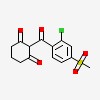
| | 2-(2-chloro-4-methylsulfonylbenzoyl)cyclohexane-1,3-dione |
| Chemidplus: | 0099105778 |
References:
| | 2-(2-chloro-4-methylsulfonylbenzoyl)cyclohexane-1,3-dione |
| NIST Chemistry WebBook: | Search Inchi |
| Pubchem (cid): | 91760 |
| Pubchem (sid): | 135049449 |
Other Information:
Potential Blenders and core components notePotential Uses:
Occurrence (nature, food, other): noteSynonyms:
| 2-(2- | chloro-4-methanesulfonylbenzoyl)-1,3-cyclohexanedione | | 2-(2- | chloro-4-methylsulfonylbenzoyl)cyclohexane-1,3-dione | | 1,3- | cyclohexanedione, 2-(2-chloro-4-(methylsulfonyl)benzoyl)- |
Articles:
| PubMed: | Toxicity of sulcotrione and grape marc on Vicia faba cells. |
| PubMed: | Efficient removal of sulcotrione and its formulated compound Tangenta® in aqueous TiO2 suspension: Stability, photoproducts assessment and toxicity. |
| PubMed: | Genotoxicity of sulcotrione pesticide and photoproducts on Allium cepa root meristem. |
| PubMed: | Cytotoxicity on Allium cepa of the two main sulcotrione photoproducts, xanthene-1,9-dione-3,4-dihydro-6-methylsulphonyl and 2-chloro-4-mesylbenzoic acid. |
| PubMed: | Triketone toxicity: a report on two cases of sulcotrione poisoning. |
| PubMed: | Chlorination of the β-triketone herbicides tembotrione and sulcotrione: Kinetic and mechanistic study, transformation products identification and toxicity. |
| PubMed: | Degradation of triketone herbicides, mesotrione and sulcotrione, using advanced oxidation processes. |
| PubMed: | Isolation and characterisation of a bacterial strain degrading the herbicide sulcotrione from an agricultural soil. |
| PubMed: | Degradation and mineralization of sulcotrione and mesotrione in aqueous medium by the electro-Fenton process: a kinetic study. |
| PubMed: | Isolation and characterization of Bradyrhizobium sp. SR1 degrading two β-triketone herbicides. |
| PubMed: | Delayed degradation in soil of foliar herbicides glyphosate and sulcotrione previously absorbed by plants: consequences on herbicide fate and risk assessment. |
| PubMed: | Photolysis of the herbicide sulcotrione: formation of a major photoproduct and its toxicity evaluation. |
| PubMed: | Phototransformation of pesticides on plant leaves: the case of sulcotrione. |
| PubMed: | Soil activity and persistence of sulcotrione and mesotrione. |
| PubMed: | Sulcotrione versus atrazine transport and degradation in soil columns. |
| PubMed: | New insights into pesticide photoprotection. |
| PubMed: | Behaviour of sulcotrione and mesotrione in two soils. |
| PubMed: | Photodegradation product of sulcotrione and the physiological response of maize (Zea mays) and white mustard (Sinapis alba). |
| PubMed: | Phototransformation of the herbicide sulcotrione on maize cuticular wax. |
| PubMed: | Influence of soil properties on the adsorption-desorption of sulcotrione and its hydrolysis metabolites on various soils. |
| PubMed: | Environmental fate of herbicides trifluralin, metazachlor, metamitron and sulcotrione compared with that of glyphosate, a substitute broad spectrum herbicide for different glyphosate-resistant crops. |
| PubMed: | Extraction procedures for the study of phytotoxicity and degradation processes of selected triketones in a water ecosystem. |
| PubMed: | Toxicity assessment of the herbicides sulcotrione and mesotrione toward two reference environmental microorganisms: Tetrahymena pyriformis and Vibrio fischeri. |
| PubMed: | Photodegradation of sulcotrione in various aquatic environments and toxicity of its photoproducts for some marine micro-organisms. |
| PubMed: | Novel bacterial bioassay for a high-throughput screening of 4-hydroxyphenylpyruvate dioxygenase inhibitors. |
| PubMed: | Quantification of the new triketone herbicides, sulcotrione and mesotrione, and other important herbicides and metabolites, at the ng/l level in surface waters using liquid chromatography-tandem mass spectrometry. |
| PubMed: | Photolysis of tembotrione and its main by-products under extreme artificial conditions: comparison with another β-triketone herbicide. |
| PubMed: | Inhibition of Barnyardgrass 4-Hydroxyphenylpyruvate Dioxygenase by Sulcotrione. |
| PubMed: | Sulcotrione soil metabolism in summer corn crops. |
| PubMed: | Soil dissipation of the post-emergence herbicide sulcotrione in maize crops treated with organic fertilizers. |
| PubMed: | Inhibition of herbicide photodegradation by plant products. |
| PubMed: | Sensitivity of locally naturalized Panicum species to HPPD- and ALS-inhibiting herbicides in maize. |
| PubMed: | Design, synthesis, and herbicidal activity of novel substituted 3-(pyridin-2-yl)benzenesulfonamide derivatives. |
| PubMed: | Biosynthesis and functions of a melanoid pigment produced by species of the sporothrix complex in the presence of L-tyrosine. |
| PubMed: | Quantitative assessment of the contribution of high resolution mass spectrometric analysis to the reliability of compound confirmation. |
| PubMed: | Sensitivity of Echinochloa muricata and Echinochloa crus-galli to HPPD- and ALS-inhibiting herbicides in corn. |
| PubMed: | Photoprotection by plant extracts: a new ecological means to reduce pesticide photodegradation. |
| PubMed: | Glyphosate adsorption in soils compared to herbicides replaced with the introduction of glyphosate resistant crops. |
| PubMed: | Soil persistence of 4-HPPD-inhibitors in different soil types. |
| PubMed: | Primus (florasulam 50 G/L), a new triazolopyrimidine sulfonanilide herbicide to control broad-leaved weeds in maize when applied in early postemergence (1 to 6 leaf stage of maize). Preliminary results. |
| PubMed: | Pyomelanin is produced by Shewanella algae BrY and affected by exogenous iron. |
| PubMed: | Identification of a novel 4-hydroxyphenylpyruvate dioxygenase from the soil metagenome. |
| PubMed: | Characterization of transplastomic tobacco plants with a plastid localized barley 4-hydroxyphenylpyruvate dioxygenase. |
| PubMed: | Temporally resolved GC-MS-based metabolic profiling of herbicide treated plants treated reveals that changes in polar primary metabolites alone can distinguish herbicides of differing mode of action. |
| PubMed: | Solid-phase fluoroimmunoassay for the determination of mesotrione--a novel triketone herbicide--in water with direct measurement of the fluorescence onto the solid support. |
| PubMed: | Beta-triketone inhibitors of plant p-hydroxyphenylpyruvate dioxygenase: modeling and comparative molecular field analysis of their interactions. |
| PubMed: | Isolation and characterization of mesotrione-degrading Bacillus sp. from soil. |
| PubMed: | Ultra-pressure liquid chromatography-electrospray tandem mass spectrometry for multiresidue determination of pesticides in water. |
| PubMed: | A quantitative structure-activity relationship study of herbicidal analogues of alpha-hydroxy-substituted 3-benzylidenepyrrolidene-2,4-diones. |
| PubMed: | Dose-response relationships between herbicides with different modes of action and growth of Lemna paucicostata: an improved ecotoxicological method. |
| PubMed: | Isolation and heterologous expression of a gene encoding 4-hydroxyphenylpyruvate dioxygenase from the wheat leaf-spot pathogen, Mycosphaerella graminicola. |
| PubMed: | Inhibition of 4-hydroxyphenylpyruvate dioxygenase by 2-(2-nitro-4-trifluoromethylbenzoyl)-cyclohexane-1,3-dione and 2-(2-chloro-4-methanesulfonylbenzoyl)-cyclohexane-1,3-dione. |
| PubMed: | Determination of kinetic and equilibrium regimes in the operation of polar organic chemical integrative samplers. Application to the passive sampling of the polar herbicides in aquatic environments. |
| PubMed: | p-Hydroxyphenylpyruvate dioxygenase is a herbicidal target site for beta-triketones from Leptospermum scoparium. |
| PubMed: | Constitutive overexpression of barley 4-hydroxyphenylpyruvate dioxygenase in tobacco results in elevation of the vitamin E content in seeds but not in leaves. |
| PubMed: | Technical advance: application of high-performance liquid chromatography with photodiode array detection to the metabolic profiling of plant isoprenoids. |
| PubMed: | SC-0051, a 2-benzoyl-cyclohexane-1,3-dione bleaching herbicide, is a potent inhibitor of the enzyme p-hydroxyphenylpyruvate dioxygenase. |
|
 3D/inchi