
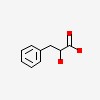
dextro,laevo-3-phenyl lactic acid
benzenepropanoic acid, .alpha.-hydroxy-, (.+/-.)-
 
Notes:
Phenyllactic acid a product of phenylalanine catabolism, appearing prominently in the urine in individuals with phenylketonuria. Levels of several phenylalanine metabolites, including phenylacetate (PAA), phenyllactate (PLA), and phenylpyruvate (PPA)) are elevated in Phenylketonuria (PKU) (OMIM 261600). Phenyllactic acid is likely produced from phenylpyruvate via the action of lactate dehydrogenase. The D-form of this organic acid is typically derived from bacterial sources while the L-form is almost certainly endogenous. Levels of phenyllactate are normally very low in blood or urine. High levels of PLA in the urine or blood are often indicative of phenylketonuria (PKU) and hyperphenylalaninemia (HPA). PKU is due to lack of the enzyme phenylalanine hydroxylase (PAH), so that phenylalanine is converted not to tyrosine but to phenylpyruvic acid (a precursor of phenylactate). In particular, excessive phenylalanine is typically metabolized into phenylketones through, a transaminase pathway route involving glutamate. Metabolites of this transamination reaction include phenylacetate, phenylpyruvate and phenethylamine. In persons with PKU, dietary phenylalanine either accumulates in the body or some of it is converted to phenylpyruvic acid and then to phenyllactate through the action of lactate dehydrogenase. Individuals with PKU tend to excrete large quantities of phenylpyruvate, phenylacetate and phenyllactate, along with phenylalanine, in their urine. If untreated, mental retardation effects and microcephaly are evident by the first year along with other symptoms which include: unusual irritability, epileptic seizures and skin lesions. Hyperactivity, EEG abnormalities and seizures, and severe learning disabilities are major clinical problems later in life. A "musty or mousy" odor of skin, hair, sweat and urine (due to phenylacetate accumulation); and a tendency to hypopigmentation and eczema are also observed. The neural-development effects of PKU are primarily due to the disruption of neurotransmitter synthesis. In particular, phenylalanine is a large, neutral amino acid which moves across the blood-brain barrier (BBB) via the large neutral amino acid transporter (LNAAT). Excessive phenylalanine in the blood saturates the transporter. Thus, excessive levels of phenylalanine significantly decrease the levels of other LNAAs in the brain. But since these amino acids are required for protein and neurotransmitter synthesis, phenylalanine accumulation disrupts brain development, leading to mental retardation. PMID: 10790306; OMIM: 261600 [HMDB]
  • BOC Sciences
    • BOC Sciences
      Best of Chemicals Supplier
      Quality supplier of research chemicals and biochemicals including inhibitors, building blocks, GMP Products, impurities and metabolites, APIs for Veterinary, Natural Compounds, ADCs, Stem Cell Molecule and chiral compounds.
      BOC Sciences provides a wide range of services to support the pharmaceutical industry through all stages of drug discovery including Custom Synthesis of those chemicals that are not in stock, Isotope Labeling Service, Chiral Synthesis and Resolution, Bioconjugation, PEGylation services, analytical services.
      BOC Sciences is a brand of BOCSCI Inc. We leverage our wide spectrum of business in the fields of development, manufacturing, marketing, and distribution to help you make best-informed decisions tailored to your evolving needs for premium chemicals. Our complete suite of CRO services spans the entire molecule development pipeline including contract research for target identification, building blocks, compound synthesis, biochemical and cellular analysis, preclinical animal tests, and clinical studies.
      Email: Marketing
      US Email: Marketing
      Email: Sales
      US Email: Sales
      Voice: 1-631-485-4226
      Fax: 1-631-614-7828
      US Voice: 1-631-485-4226
      US Fax: 1-631-614-7828
      Europe44-203-286-1088
      Facebook
      Twitter
      Linkedin
      Blog
      Get the App!
      Product(s):
      828-01-3 DL-b-PHENYLLACTIC ACID
       
Synonyms   Articles   Notes   Search
CAS Number: 828-01-3Picture of molecule3D/inchi
Other(deleted CASRN): 156-05-8
ECHA EINECS - REACH Pre-Reg: 212-580-4
FDA UNII: SC6T4O59BK
Nikkaji Web: J10.217B
Beilstein Number: 2209791
MDL: MFCD00065928
XlogP3-AA: 1.10 (est)
Molecular Weight: 166.17630000
Formula: C9 H10 O3
BioActivity Summary: listing
NMR Predictor: Predict (works with chrome or firefox)
Category: natural substances and extractives
 
US / EU / FDA / JECFA / FEMA / FLAVIS / Scholar / Patent Information:
Google Scholar: Search
Google Books: Search
Google Scholar: with word "volatile"Search
Google Scholar: with word "flavor"Search
Google Scholar: with word "odor"Search
Google Patents: Search
US Patents: Search
EU Patents: Search
Pubchem Patents: Search
PubMed: Search
NCBI: Search
Synonyms   Articles   Notes   Search   Top
Physical Properties:
Appearance: white to cream crystalline powder (est)
Assay: 95.00 to 100.00 % 
Food Chemicals Codex Listed: No
Melting Point: 95.00 to  98.00 °C. @ 760.00 mm Hg
Boiling Point: 331.00 °C. @ 332.00 mm Hg (est)
Flash Point: 335.00 °F. TCC ( 168.50 °C. ) (est)
logP (o/w): 0.250 (est)
Soluble in:
 water, 6.421e+004 mg/L @ 25 °C (est)
Synonyms   Articles   Notes   Search   Top
Organoleptic Properties:
 
Odor and/or flavor descriptions from others (if found).
 
 
Synonyms   Articles   Notes   Search   Top
Cosmetic Information:
None found
Synonyms   Articles   Notes   Search   Top
Suppliers:
BOC Sciences
For experimental / research use only.
DL-b-PHENYLLACTIC ACID
Carbosynth
For experimental / research use only.
DL-3-Phenyllactic acid
Santa Cruz Biotechnology
For experimental / research use only.
DL-3-Phenyllactic Acid
Sigma-Aldrich: Aldrich
For experimental / research use only.
DL-3-Phenyllactic acid ≥98%
Synonyms   Articles   Notes   Search   Top
Safety Information:
Preferred SDS: View
 
Hazards identification
 
Classification of the substance or mixture
GHS Classification in accordance with 29 CFR 1910 (OSHA HCS)
None found.
GHS Label elements, including precautionary statements
 
Pictogram
 
Hazard statement(s)
None found.
Precautionary statement(s)
None found.
Oral/Parenteral Toxicity:
Not determined
Dermal Toxicity:
Not determined
Inhalation Toxicity:
Not determined
Synonyms   Articles   Notes   Search   Top
Safety in Use Information:
Category: natural substances and extractives
Recommendation for dextro,laevo-3-phenyl lactic acid usage levels up to:
 not for fragrance use.
 
Recommendation for dextro,laevo-3-phenyl lactic acid flavor usage levels up to:
 not for flavor use.
Synonyms   Articles   Notes   Search   Top
Safety References:
EPI System: View
AIDS Citations: Search
Cancer Citations: Search
Toxicology Citations: Search
EPA ACToR: Toxicology Data
EPA Substance Registry Services (SRS): Registry
Laboratory Chemical Safety Summary : 3848
National Institute of Allergy and Infectious Diseases: Data
WGK Germany: 3
 2-hydroxy-3-phenylpropanoic acid
Chemidplus: 0000828013
Synonyms   Articles   Notes   Search   Top
References:
 2-hydroxy-3-phenylpropanoic acid
NIST Chemistry WebBook: Search Inchi
Pubchem (cid): 3848
Pubchem (sid): 135027969
Synonyms   Articles   Notes   Search   Top
Other Information:
(IUPAC): Atomic Weights of the Elements 2011 (pdf)
Videos: The Periodic Table of Videos
tgsc: Atomic Weights use for this web site
(IUPAC): Periodic Table of the Elements
CHEBI: View
CHEMBL: View
Golm Metabolome Database: Search
KEGG (GenomeNet): C01479
HMDB (The Human Metabolome Database): HMDB00779
FooDB: FDB022236
VCF-Online: VCF Volatile Compounds in Food
Synonyms   Articles   Notes   Search   Top
Potential Blenders and core components note
 
None Found
 
Synonyms   Articles   Notes   Search   Top
Potential Uses:
None Found
Synonyms   Articles   Notes   Search   Top
Occurrence (nature, food, other): note
 lysimachia candida
Search Trop  Picture
Synonyms   Articles   Notes   Search   Top
Synonyms:
 benzenepropanoic acid, .alpha.-hydroxy-
 benzenepropanoic acid, .alpha.-hydroxy-, (.+/-.)-
 benzenepropanoic acid, alpha-hydroxy-
2-hydroxy-3-phenyl propanoic acid
2-hydroxy-3-phenylpropanoic acid
DL-3-phenyl lactic acid
3-phenyllactic acid
beta-phenyllactic acid
Synonyms   Articles   Notes   Search   Top
Please share your Comments.
Email Address:


Top of Page Home
Copyright © 1980-2021 Perflavory ™ Disclaimer Privacy Policy