|
Category: pharmaceuticals / chemical synthisis
US / EU / FDA / JECFA / FEMA / FLAVIS / Scholar / Patent Information:
Physical Properties:
| Appearance: | white powder (est) |
| Assay: | 95.00 to 100.00 %
|
| Food Chemicals Codex Listed: | No |
| Boiling Point: | 364.90 °C. @ 760.00 mm Hg (est)
|
| Vapor Pressure: | 0.000016 mmHg @ 25.00 °C. (est) |
| Flash Point: | 346.00 °F. TCC ( 174.50 °C. ) (est)
|
| logP (o/w): | 2.519 (est) |
| Soluble in: |
| | water, 7.438e+004 mg/L @ 25 °C (est) |
Organoleptic Properties:
| |
| Odor and/or flavor descriptions from others (if found). |
| |
| |
Cosmetic Information:
Suppliers:
Safety Information:
| Preferred SDS: View |
| |
| Hazards identification |
| |
| Classification of the substance or mixture |
| GHS Classification in accordance with 29 CFR 1910 (OSHA HCS) |
| None found. |
| GHS Label elements, including precautionary statements |
| |
| Pictogram | |
| |
| Hazard statement(s) |
| None found. |
| Precautionary statement(s) |
| None found. |
| Oral/Parenteral Toxicity: |
intravenous-mouse LD50 62 mg/kg
Journal of Laboratory and Clinical Medicine. Vol. 33, Pg. 325, 1948.
oral-mouse LD50 470 mg/kg
BEHAVIORAL: CONVULSIONS OR EFFECT ON SEIZURE THRESHOLD
Journal of Laboratory and Clinical Medicine. Vol. 33, Pg. 325, 1948.
intravenous-rabbit LD50 49 mg/kg
Journal of Laboratory and Clinical Medicine. Vol. 33, Pg. 325, 1948.
oral-rabbit LD50 250 mg/kg
Journal of Laboratory and Clinical Medicine. Vol. 33, Pg. 325, 1948.
oral-rat LDLo 600 mg/kg
BEHAVIORAL: CONVULSIONS OR EFFECT ON SEIZURE THRESHOLD
BEHAVIORAL: FOOD INTAKE (ANIMAL)
Journal of the American Pharmaceutical Association, Scientific Edition. Vol. 37, Pg. 311, 1948.
|
| Dermal Toxicity: |
subcutaneous-mouse LD50 460 mg/kg
Journal of Laboratory and Clinical Medicine. Vol. 33, Pg. 325, 1948.
subcutaneous-rat LD50 440 mg/kg
Journal of Laboratory and Clinical Medicine. Vol. 33, Pg. 325, 1948.
|
| Inhalation Toxicity: |
|
Not determined
|
Safety in Use Information:
| Category: | pharmaceuticals / chemical synthisis |
| Recommendation for doxl amine succinate usage levels up to: | | | not for fragrance use.
|
| |
| Recommendation for doxl amine succinate flavor usage levels up to: |
| | not for flavor use.
|
Safety References:
References:
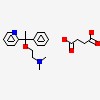
| | butanedioicacid;N,N-dimethyl-2-(1-phenyl-1-pyridin-2-ylethoxy)ethanamine |
| NIST Chemistry WebBook: | Search Inchi |
| Pubchem (cid): | 11224 |
| Pubchem (sid): | 134977827 |
Other Information:
Potential Blenders and core components notePotential Uses:
Occurrence (nature, food, other): noteSynonyms:
| | alsadorm | | | bendectin | | | butanedioic acid compd. with N,N-Dimethyl-2-[1-phenyl-1-(2-pyridinyl)ethoxy]ethanamine (1:1) | | | butanedioic acid, compd. with N, N-dimethyl-2-[1-phenyl-1- (2-pyridinyl)ethoxy]ethanamine (1:1) | | | butanedioic acid, compd. with N,N-dimethyl-2-(1-phenyl-1-(2-pyridinyl)ethoxy)ethanamine (1:1) | | | butanedioicacid;N,N-dimethyl-2-(1-phenyl-1-pyridin-2-ylethoxy)ethanamine | | | contac nighttime cold medicine | | | decapryn | | | decarpyn succinate (1:1) | | N,N- | dimethyl-2-(1-phenyl-1-pyridin-2-ylethoxy)ethanamine butanedioate | | N,N- | dimethyl-2-[1-phenyl-1-(2-pyridinyl)ethoxy]ethanamine succinate (1:1) | | N,N- | dimethyl-2-[1-phenyl-1-(pyridin-2-yl)ethoxy]ethanamine butanedioate (1:1) | | N,N- | dimethyl-2-[1-phenyl-1-(pyridin-2-yl)ethoxy]ethanamine succinate (1:1) | | 2-(a-(2- | dimethylaminoethoxy)-a-methylbenzyl)pyridine succinate | | | dimethylaminoethoxymethylbenzylpyridine succinate | | 2- | dimethylaminoethoxyphenylmethyl-2-picoline succinate | | | doxlamine succinate | | | doxyl amine hydrogen succinate | | | ethanamine, N,N-dimethyl-2-[1-phenyl-1-(2-pyridinyl)ethoxy]-, butanedioate (1:1) | | | evigoa D | | | gittalun | | | hoggar N | | | mereprine | | | pyridine, 2-(a-(2-(dimethylamino)ethoxy)-a-methylbenzyl)-, succinate (1:1) | | | pyridine, 2-[a-[2- (dimethylamino)ethoxy]-a-methylbenzyl]-, succinate (1:1) | | | sedaplus | | | unisom |
Articles:
|


 3D/inchi