Articles:
4',5-dihydroxy-3',6,7-trimethoxyflavone
Notes:
None found
| CAS Number: | 41365-32-6 | 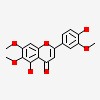 3D/inchi 3D/inchi
|
| FDA UNII: | 08DZZ529FE | |
| Nikkaji Web: | J372.166C | |
| Beilstein Number: | 1355108 | |
| MDL: | MFCD01083015 | |
| XlogP3-AA: | 2.90 (est) | |
| Molecular Weight: | 344.31992000 | |
| Formula: | C18 H16 O7 | |
| BioActivity Summary: | listing | |
| NMR Predictor: | Predict (works with chrome or firefox) | |
Category: natural substances and extractives
US / EU / FDA / JECFA / FEMA / FLAVIS / Scholar / Patent Information:
| Google Scholar: | Search |
| Google Books: | Search |
| Google Scholar: with word "volatile" | Search |
| Google Scholar: with word "flavor" | Search |
| Google Scholar: with word "odor" | Search |
| Google Patents: | Search |
| US Patents: | Search |
| EU Patents: | Search |
| Pubchem Patents: | Search |
| PubMed: | Search |
| NCBI: | Search |
Physical Properties:
| Assay: | 95.00 to 100.00 % |
| Food Chemicals Codex Listed: | No |
| Boiling Point: | 585.00 °C. @ 760.00 mm Hg (est) |
| Flash Point: | 419.00 °F. TCC ( 215.20 °C. ) (est) |
| logP (o/w): | 1.670 (est) |
| Soluble in: | |
| water, 45.53 mg/L @ 25 °C (est) | |
Organoleptic Properties:
| Odor and/or flavor descriptions from others (if found). | |
Cosmetic Information:
| None found |
Suppliers:
| Coompo |
| For experimental / research use only. |
| Cirsilineol from Plants ≥98%
Odor: characteristic Use: Cirsilineol significantly inhibited proliferation of Caov-3, Skov-3, PC3 and Hela cells in a concentration-dependent manner. The compound also dose-dependently induced apoptosis in Caov-3 cells, as determined by annexin V/propidium iodide staining. Besides, cirsilineol induced a remarkable change in mitochondrial membrane potential and caused release of cytochrome c to cytosol. Furthermore, the compound caused a marked activation of capase-3, caspase-9 and poly (ADP-ribose) polymerase (PARP). These results suggested that the induction of apoptosis via the mitochondrial pathway was involved in the anti-proliferative activity of cirsilineol against cancer cells.
Cirsilineol significantly ameliorated trinitro-benzene sulfonic acid (TNBS)-induced T-cell-mediated experimental colitis in mice, which was closely associated with reduced autoreactive T-cell proliferation and activation. Moreover, the regulatory action of pro-inflammatory and anti-inflammatory cytokine by cirsilineol treatment was found to decrease the activity of effector Th1 cells but increase the activity of regulatory T cells as characterized by down-regulation of IFN-gamma and corresponding up-regulation of IL-10 and TGF-beta. The therapeutic effect of cirsilineol was attributable to a novel regulatory mechanism with selective inhibiting IFN-gamma signaling in colonic lamina propria CD4+ T cells, which was mediated through down-regulating STAT1 activation and T-bet expression. Furthermore, cirsilineol was found to down-regulate the activation of JAK2, a critical kinase for IFN-gamma/STAT1 signaling, and abrogate the expression of T-bet, resulting in markedly decreased proliferation and activation of T cells in vitro. Importantly, the inhibition of IFN-gamma/STAT1 signaling by cirsilineol was reversible in the presence of high level of IFN-gamma. These results strongly suggest that cirsilineol might be potentially useful for treating T-cell-mediated human inflammatory bowel diseases. |
| Sigma-Aldrich |
| For experimental / research use only. |
| Cirsilineol |
Safety Information:
| Hazards identification | |
| Classification of the substance or mixture | |
| GHS Classification in accordance with 29 CFR 1910 (OSHA HCS) | |
| None found. | |
| GHS Label elements, including precautionary statements | |
| Pictogram | |
| Hazard statement(s) | |
| None found. | |
| Precautionary statement(s) | |
| None found. | |
| Oral/Parenteral Toxicity: | |
| Not determined | |
| Dermal Toxicity: | |
| Not determined | |
| Inhalation Toxicity: | |
| Not determined | |
Safety in Use Information:
| Category: | natural substances and extractives | ||
| Recommendation for cirsilineol usage levels up to: | |||
| not for fragrance use. | |||
| Recommendation for cirsilineol flavor usage levels up to: | |||
| not for flavor use. | |||
Safety References:
| EPI System: | View |
| AIDS Citations: | Search |
| Cancer Citations: | Search |
| Toxicology Citations: | Search |
| EPA ACToR: | Toxicology Data |
| EPA Substance Registry Services (SRS): | Registry |
| Laboratory Chemical Safety Summary : | 162464 |
| National Institute of Allergy and Infectious Diseases: | Data |
| WGK Germany: | 3 |
| 5-hydroxy-2-(4-hydroxy-3-methoxyphenyl)-6,7-dimethoxychromen-4-one | |
| Chemidplus: | 0041365326 |
References:
| 5-hydroxy-2-(4-hydroxy-3-methoxyphenyl)-6,7-dimethoxychromen-4-one | |
| NIST Chemistry WebBook: | Search Inchi |
| Pubchem (cid): | 162464 |
| Pubchem (sid): | 135144564 |
Other Information:
| (IUPAC): | Atomic Weights of the Elements 2011 (pdf) |
| Videos: | The Periodic Table of Videos |
| tgsc: | Atomic Weights use for this web site |
| (IUPAC): | Periodic Table of the Elements |
| CHEBI: | View |
| CHEMBL: | View |
| KEGG (GenomeNet): | C10032 |
| HMDB (The Human Metabolome Database): | Search |
| FooDB: | FDB016702 |
| VCF-Online: | VCF Volatile Compounds in Food |
| ChemSpider: | View |
| Wikipedia: | View |
Potential Blenders and core components note
| None Found | ||
Potential Uses:
| None Found |
Occurrence (nature, food, other): note
| hyssop Search Trop Picture | |
| lippia citriodora Search Trop Picture | |
| sage plant Search Trop Picture | |
| tarragon plant Search Trop Picture | |
| thyme leaf Search Trop Picture |
Synonyms:
| 4H-1- | benzopyran-4-one, 5-hydroxy-2-(4-hydroxy-3-methoxyphenyl)-6,7-dimethoxy- |
| cirsileneol | |
| 4',5- | dihydroxy-3',6,7-trimethoxyflavone |
| eupatrin | |
| 5- | hydroxy-2-(4-hydroxy-3-methoxyphenyl)-6,7-dimethoxy-4H-chromen-4-one |
| 5- | hydroxy-2-(4-hydroxy-3-methoxyphenyl)-6,7-dimethoxychromen-4-one |