Articles:
acetonecarboxylic acid
Notes:
It is a weak organic acid and can be produced in the human liver under certain conditions of poor metabolism leading to excessive fatty acid breakdown (diabetes mellitus leading to diabetic ketoacidosis), it is then partially converted to acetone by decarboxylation and excreted either in urine or through respiration. Persistent mild hyperketonemia is a common finding in newborns. These compounds serve as an indispensable source of energy for extrahepatic tissues, especially the brain and lung of developing rats. Another important function of ketone bodies is to provide acetoacetyl-CoA and acetyl-CoA for synthesis of cholesterol, fatty acids, and complex lipids. During the early postnatal period, acetoacetate (AcAc) and beta-hydroxybutyrate are preferred over glucose as substrates for synthesis of phospholipids and sphingolipids in accord with requirements for brain growth and myelination. Thus, during the first 2 wk of postnatal development, when the accumulation of cholesterol and phospholipids accelerates, the proportion of ketone bodies incorporated into these lipids increases. On the other hand, an increased proportion of ketone bodies are utilized for cerebroside synthesis during the period of active myelination. In the lung, AcAc serves better than glucose as a precursor for the synthesis of lung phospholipids. The synthesized lipids, particularly dipalmityl phosphatidylcholine, are incorporated into surfactant, and thus have a potential role in supplying adequate surfactant lipids to maintain lung function during the early days of life. (PMID 3884391) The acid is also present in the metabolism of those undergoing starvation or prolonged physical exertion as part of gluconeogenesis. When ketone bodies are measured by way of urine concentration, acetoacetic acid, along with beta-hydroxybutyric acid or acetone, is what is detected. [HMDB]

-
BOC Sciences Best of Chemicals Supplier Quality supplier of research chemicals and biochemicals including inhibitors, building blocks, GMP Products, impurities and metabolites, APIs for Veterinary, Natural Compounds, ADCs, Stem Cell Molecule and chiral compounds. BOC Sciences provides a wide range of services to support the pharmaceutical industry through all stages of drug discovery including Custom Synthesis of those chemicals that are not in stock, Isotope Labeling Service, Chiral Synthesis and Resolution, Bioconjugation, PEGylation services, analytical services. BOC Sciences is a brand of BOCSCI Inc. We leverage our wide spectrum of business in the fields of development, manufacturing, marketing, and distribution to help you make best-informed decisions tailored to your evolving needs for premium chemicals. Our complete suite of CRO services spans the entire molecule development pipeline including contract research for target identification, building blocks, compound synthesis, biochemical and cellular analysis, preclinical animal tests, and clinical studies. Email: Marketing US Email: Marketing Email: Sales US Email: Sales Voice: 1-631-485-4226 Fax: 1-631-614-7828 US Voice: 1-631-485-4226 US Fax: 1-631-614-7828 Europe 44-203-286-1088 Facebook Twitter Linkedin Blog Get the App! Product(s): 541-50-4 3-Oxobutanoic Acid
-
| CAS Number: | 541-50-4 | 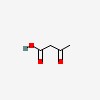 3D/inchi 3D/inchi
|
| FDA UNII: | 4ZI204Y1MC | |
| Nikkaji Web: | J4.508J | |
| XlogP3-AA: | -0.40 (est) | |
| Molecular Weight: | 102.08942000 | |
| Formula: | C4 H6 O3 | |
| NMR Predictor: | Predict (works with chrome or firefox) | |
Category: cosmetic agents
US / EU / FDA / JECFA / FEMA / FLAVIS / Scholar / Patent Information:
| Google Scholar: | Search |
| Google Books: | Search |
| Google Scholar: with word "volatile" | Search |
| Google Scholar: with word "flavor" | Search |
| Google Scholar: with word "odor" | Search |
| Google Patents: | Search |
| US Patents: | Search |
| EU Patents: | Search |
| Pubchem Patents: | Search |
| PubMed: | Search |
| NCBI: | Search |
Physical Properties:
| Assay: | 95.00 to 100.00 % |
| Food Chemicals Codex Listed: | No |
| Melting Point: | 36.00 to 37.00 °C. @ 760.00 mm Hg |
| Boiling Point: | 237.00 to 239.00 °C. @ 760.00 mm Hg |
| Vapor Pressure: | 0.218000 mmHg @ 25.00 °C. |
| Flash Point: | 233.00 °F. TCC ( 111.67 °C. ) |
| logP (o/w): | -0.467 (est) |
| Soluble in: | |
| water, 1.00E+06 mg/L @ 20 °C (exp) | |
| Similar Items: note | |
| 2-oxobutanoic acid | |
Organoleptic Properties:
| Odor and/or flavor descriptions from others (if found). | |
Cosmetic Information:
| CosIng: | cosmetic data |
| Cosmetic Uses: |
skin conditioning |
Suppliers:
| BOC Sciences |
| For experimental / research use only. |
| 3-Oxobutanoic Acid |
Safety Information:
| Hazards identification | |
| Classification of the substance or mixture | |
| GHS Classification in accordance with 29 CFR 1910 (OSHA HCS) | |
| None found. | |
| GHS Label elements, including precautionary statements | |
| Pictogram | |
| Hazard statement(s) | |
| None found. | |
| Precautionary statement(s) | |
| None found. | |
| Oral/Parenteral Toxicity: | |
| Not determined | |
| Dermal Toxicity: | |
| Not determined | |
| Inhalation Toxicity: | |
| Not determined | |
Safety in Use Information:
| Category: | cosmetic agents | ||
| Recommendation for diacetic acid usage levels up to: | |||
| not for fragrance use. | |||
| Recommendation for diacetic acid flavor usage levels up to: | |||
| not for flavor use. | |||
Safety References:
| EPI System: | View |
| AIDS Citations: | Search |
| Cancer Citations: | Search |
| Toxicology Citations: | Search |
| EPA ACToR: | Toxicology Data |
| EPA Substance Registry Services (SRS): | Registry |
| Laboratory Chemical Safety Summary : | 96 |
| National Institute of Allergy and Infectious Diseases: | Data |
| 3-oxobutanoic acid | |
| Chemidplus: | 0000541504 |
References:
| 3-oxobutanoic acid | |
| NIST Chemistry WebBook: | Search Inchi |
| Pubchem (cid): | 96 |
| Pubchem (sid): | 134976127 |
Other Information:
| (IUPAC): | Atomic Weights of the Elements 2011 (pdf) |
| Videos: | The Periodic Table of Videos |
| tgsc: | Atomic Weights use for this web site |
| (IUPAC): | Periodic Table of the Elements |
| CHEBI: | View |
| CHEMBL: | View |
| Golm Metabolome Database: | Search |
| UM BBD: | Search |
| KEGG (GenomeNet): | C00164 |
| HMDB (The Human Metabolome Database): | HMDB00060 |
| FooDB: | FDB021801 |
| ChemSpider: | View |
| Wikipedia: | View |
Potential Blenders and core components note
| None Found | ||
Potential Uses:
| skin conditioning |
Occurrence (nature, food, other): note
| not found in nature |
Synonyms:
| AAE | |
| acetoacetic acid | |
| acetonecarboxylic acid | |
| acetylacetic acid | |
| 3-oxo | butanoic acid |
| butanoic acid, 3-oxo- | |
| 3-keto | butyric acid |
| beta-keto | butyric acid |
| LIN |