|
Category: natural substances and extractives
US / EU / FDA / JECFA / FEMA / FLAVIS / Scholar / Patent Information:
Physical Properties:
| Assay: | 95.00 to 100.00 %
|
| Food Chemicals Codex Listed: | No |
| Boiling Point: | 401.23 °C. @ 760.00 mm Hg (est)
|
| Flash Point: | 411.00 °F. TCC ( 210.60 °C. ) (est)
|
| logP (o/w): | 1.189 (est) |
| Soluble in: |
| | water, 5542 mg/L @ 25 °C (est) |
Organoleptic Properties:
| |
| Odor and/or flavor descriptions from others (if found). |
| |
| |
Cosmetic Information:
Suppliers:
Safety Information:
| |
| Hazards identification |
| |
| Classification of the substance or mixture |
| GHS Classification in accordance with 29 CFR 1910 (OSHA HCS) |
| None found. |
| GHS Label elements, including precautionary statements |
| |
| Pictogram | |
| |
| Hazard statement(s) |
| None found. |
| Precautionary statement(s) |
| None found. |
| Oral/Parenteral Toxicity: |
|
Not determined
|
| Dermal Toxicity: |
|
Not determined
|
| Inhalation Toxicity: |
|
Not determined
|
Safety in Use Information:
| Category: | natural substances and extractives |
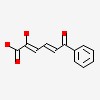
| Recommendation for 2-hydroxy-6-oxo-6-phenyl hexa-2,4-dienoate usage levels up to: | | | not for fragrance use.
|
| |
| Recommendation for 2-hydroxy-6-oxo-6-phenyl hexa-2,4-dienoate flavor usage levels up to: |
| | not for flavor use.
|
Safety References:
References:
Other Information:
Potential Blenders and core components notePotential Uses:
Occurrence (nature, food, other): noteSynonyms:
| 2,4- | hexadienoic acid, 2-hydroxy-6-oxo-6-phenyl- | | | HOPDA
| | (3E,5Z)-6- | hydroxy-2-oxo-6-phenylhexa-3,5-dienoic acid | | 2- | hydroxy-6-oxo-6-phenyl-2,4-hexadienoic acid |
Articles:
| PubMed: | Mechanism-based inhibition of HsaD: a C-C bond hydrolase essential for survival of Mycobacterium tuberculosis in macrophage. |
| PubMed: | A substrate-assisted mechanism of nucleophile activation in a Ser-His-Asp containing C-C bond hydrolase. |
| PubMed: | The lid domain of the MCP hydrolase DxnB2 contributes to the reactivity toward recalcitrant PCB metabolites. |
| PubMed: | Single residues dictate the co-evolution of dual esterases: MCP hydrolases from the α/β hydrolase family. |
| PubMed: | The key role of a non-active-site residue Met148 on the catalytic efficiency of meta-cleavage product hydrolase BphD. |
| PubMed: | The catalytic serine of meta-cleavage product hydrolases is activated differently for C-O bond cleavage than for C-C bond cleavage. |
| PubMed: | Potential for biodegradation of polychlorinated biphenyls (PCBs) by Sinorhizobium meliloti. |
| PubMed: | Flow cytometry-based method for isolating live bacteria with meta-cleavage activity on dihydroxy compounds of biphenyl. |
| PubMed: | Characterization of a carbon-carbon hydrolase from Mycobacterium tuberculosis involved in cholesterol metabolism. |
| PubMed: | Characterization and functional analysis of a novel gene cluster involved in biphenyl degradation in Rhodococcus sp. strain R04. |
| PubMed: | The molecular basis for inhibition of BphD, a C-C bond hydrolase involved in polychlorinated biphenyls degradation: large 3-substituents prevent tautomerization. |
| PubMed: | The tautomeric half-reaction of BphD, a C-C bond hydrolase. Kinetic and structural evidence supporting a key role for histidine 265 of the catalytic triad. |
| PubMed: | Characterization of a C-C bond hydrolase from Sphingomonas wittichii RW1 with novel specificities towards polychlorinated biphenyl metabolites. |
| PubMed: | Temperature-dependent biotransformation of 2,4'-dichlorobiphenyl by psychrotolerant Hydrogenophaga strain IA3-A: higher temperatures prevent excess accumulation of problematic meta-cleavage products. |
| PubMed: | Kinetic and structural insight into the mechanism of BphD, a C-C bond hydrolase from the biphenyl degradation pathway. |
| PubMed: | Structures of ternary complexes of BphK, a bacterial glutathione S-transferase that reductively dechlorinates polychlorinated biphenyl metabolites. |
| PubMed: | A glutathione S-transferase catalyzes the dehalogenation of inhibitory metabolites of polychlorinated biphenyls. |
| PubMed: | Expression and homology modeling of 2-aminobiphenyl-2,3-diol-1,2-dioxygenase from Pseudomonas stutzeri carbazole degradation pathway. |
| PubMed: | Characterization of the putative operon containing arylamine N-acetyltransferase (nat) in Mycobacterium bovis BCG. |
| PubMed: | Purification, characterization, and steady-state kinetics of a meta-cleavage compound hydrolase from Pseudomonas fluorescens IPO1. |
| PubMed: | Diversity of 2,3-dihydroxybiphenyl dioxygenase genes in a strong PCB degrader, Rhodococcus sp. strain RHA1. |
| PubMed: | Biodegradation of dibenzo-p-dioxin, dibenzofuran, and chlorodibenzo-p-dioxins by Pseudomonas veronii PH-03. |
| PubMed: | Crystal structure of a histidine-tagged serine hydrolase involved in the carbazole degradation (CarC enzyme). |
| PubMed: | Comparative specificities of two evolutionarily divergent hydrolases involved in microbial degradation of polychlorinated biphenyls. |
| PubMed: | Expression of the bph genes involved in biphenyl/PCB degradation in Pseudomonas sp. KKS102 induced by the biphenyl degradation intermediate, 2-hydroxy-6-oxo-6-phenylhexa-2,4-dienoic acid. |
| PubMed: | Versatile transcription of biphenyl catabolic bph operon in Pseudomonas pseudoalcaligenes KF707. |
| PubMed: | Degradation of anaerobic reductive dechlorination products of Aroclor 1242 by four aerobic bacteria. |
| PubMed: | Characterization of the pcbE gene encoding 2-hydroxypenta-2,4-dienoate hydratase in Pseudomonas sp. DJ-12. |
| PubMed: | Identification of a serine hydrolase as a key determinant in the microbial degradation of polychlorinated biphenyls. |
| PubMed: | Purification and preliminary characterization of a serine hydrolase involved in the microbial degradation of polychlorinated biphenyls. |
| PubMed: | Two nearly identical aromatic compound hydrolase genes in a strong polychlorinated biphenyl degrader, Rhodococcus sp. strain RHA1. |
| PubMed: | The bphDEF meta-cleavage pathway genes involved in biphenyl/polychlorinated biphenyl degradation are located on a linear plasmid and separated from the initial bphACB genes in Rhodococcus sp. strain RHA1. |
| PubMed: | Location and sequence analysis of a 2-hydroxy-6-oxo-6-phenylhexa-2,4-dienoate hydrolase-encoding gene (bpdF) of the biphenyl/polychlorinated biphenyl degradation pathway in Rhodococcus sp. M5. |
| PubMed: | Genetic analysis of a Pseudomonas locus encoding a pathway for biphenyl/polychlorinated biphenyl degradation. |
| PubMed: | Gene components responsible for discrete substrate specificity in the metabolism of biphenyl (bph operon) and toluene (tod operon). |
| PubMed: | Purification of two isofunctional hydrolases (EC 3.7.1.8) in the degradative pathway for dibenzofuran in Sphingomonas sp. strain RW1. |
| PubMed: | 3-(2-hydroxyphenyl)catechol as substrate for proximal meta ring cleavage in dibenzofuran degradation by Brevibacterium sp. strain DPO 1361. |
| PubMed: | Identification and localization of 3-phenylcatechol dioxygenase and 2-hydroxy-6-oxo-6-phenylhexa-2,4-dienoate hydrolase genes of Pseudomonas putida and expression in Escherichia coli. |
| PubMed: | Cloning of bacterial genes specifying degradation of 4-chlorobiphenyl from Pseudomonas putida OU83. |
| PubMed: | Metabolism of biphenyl. 2-Hydroxy-6-oxo-6-phenylhexa-2,4-dienoate: the meta-cleavage product from 2,3-dihydroxybiphenyl by Pseudomonas putida. |
|
 3D/inchi