|
Category: indirect food additives: adhesives and components of coatings
US / EU / FDA / JECFA / FEMA / FLAVIS / Scholar / Patent Information:
Physical Properties:
| Assay: | 95.00 to 100.00 %
|
| Food Chemicals Codex Listed: | No |
| Melting Point: | 342.00 °C. @ 760.00 mm Hg
|
| Boiling Point: | 419.20 °C. @ 760.00 mm Hg (est)
|
| Flash Point: | 405.00 °F. TCC ( 207.30 °C. ) (est)
|
| logP (o/w): | -0.020 (est) |
| Soluble in: |
| | water, 1000 mg/L @ 18C (exp) | | | water, 1.269e+004 mg/L @ 25 °C (est) |
Organoleptic Properties:
| |
| Odor and/or flavor descriptions from others (if found). |
| |
| |
Cosmetic Information:
Suppliers:
| AVA Biochem |
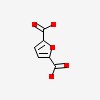
| 2,5-Furandicarboxylic Acid
Odor: characteristic Use: 2,5-furandicarboxylic acid (FDCA) is listed in a 2004 US Department of Energy National Renewable Energy Laboratory (NREL) report as one of the top twelve building blocks that can be subsequently converted to a number of high-value bio-based chemicals or materials.
Derivatives of furan produced from renewable carbohydrates are the main types of next generation platform chemicals. FDCA made from bio-based 5-HMF (5-hydroxymethylfurfural) plays a particularly important role and opens, amongst others, the door to the multi-billion bio-based packaging market. FDCA is the oxidation product of both primary alcohol and aldehyde groups of 5-HMF to carboxylic acid groups and is considered to be the most important derivative of 5-HMF. This sugar based compound is a potential replacement of terephthalic acid, which is a monomer, used in polyethylene terephthalate (PET) plastics. Amongst others, FDCA is the basis for 100% bio-based PEF (polyethylene furanoate) bottles, fibres or films. |
| BOC Sciences |
| For experimental / research use only. |
| 2,5-Furandicarboxylic acid 98%
|
| Carbosynth |
| For experimental / research use only. |
| 2,5-Furandicarboxylic Acid
|
| Santa Cruz Biotechnology |
| For experimental / research use only. |
| 2,5-Furandicarboxylic Acid
|
| Sigma-Aldrich: Aldrich |
| For experimental / research use only. |
| 2,5-Furandicarboxylic Acid 97%
|
| TCI AMERICA |
| For experimental / research use only. |
| 2,5-Furandicarboxylic Acid >98.0%(HPLC)(T)
|
Safety Information:
| Preferred SDS: View |
| |
| Hazards identification |
| |
| Classification of the substance or mixture |
| GHS Classification in accordance with 29 CFR 1910 (OSHA HCS) |
| None found. |
| GHS Label elements, including precautionary statements |
| |
| Pictogram | |
| |
| Hazard statement(s) |
| None found. |
| Precautionary statement(s) |
| None found. |
| Oral/Parenteral Toxicity: |
|
Not determined
|
| Dermal Toxicity: |
|
Not determined
|
| Inhalation Toxicity: |
|
Not determined
|
Safety in Use Information:
| Category: | indirect food additives: adhesives and components of coatings |
| Recommendation for 2,5-furan dicarboxylic acid usage levels up to: | | | not for fragrance use.
|
| |
| Recommendation for 2,5-furan dicarboxylic acid flavor usage levels up to: |
| | not for flavor use.
|
Safety References:
| European Food Safety Authority (EFSA) reference(s): |
Scientific Opinion on the safety assessment of the substance, furan-2,5-dicarboxylic acid, CAS No 3238-40-2, for use in food contact materials
View page or View pdf |
| EPI System: | View |
| AIDS Citations: | Search |
| Cancer Citations: | Search |
| Toxicology Citations: | Search |
| EPA Substance Registry Services (TSCA): | 3238-40-2 |
| EPA ACToR: | Toxicology Data |
| EPA Substance Registry Services (SRS): | Registry |
| Laboratory Chemical Safety Summary : | 76720 |
| National Institute of Allergy and Infectious Diseases: | Data |
| WGK Germany: | 3 |
| | furan-2,5-dicarboxylic acid |
| Chemidplus: | 0003238402 |
References:
Other Information:
Potential Blenders and core components notePotential Uses:
Occurrence (nature, food, other): noteSynonyms:
| | dehydromucic acid | | | furan-2,5-dicarboxylic acid | | | furan-alpha,alpha'-dicarboxylic acid | | 2,5- | furandicarboxylic acid | | | furane-alpha,alpha'-dicarboxylic acid |
Articles:
|


 3D/inchi