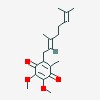
ubiquinone Q2
ubiquinone-2
 
Notes:
Coenzyme Q functions as an electron carrier and reversibly changes to either an oxidized (CoQ), intermediate (CoQ), or reduced (CoQH2) form within a biomembrane. The Coenzyme Q2 (CoQH2) form also acts as an antioxidant and prevents cell death, and thus has been successfully used as a supplement. On the other hand, the value of the CoQ/CoQH2 ratio has been shown to increase in a number of diseases, presumably due to an anti-proliferative effect involving CoQ. Induction of apoptosis by CoQ2 is dependent on p53 protein levels. Moreover, CoQ2 induces reactive oxygen species (ROS) and the phosphorylation of p53. An antioxidant, l-ascorbic acid, inhibited CoQ2-induced p53 phosphorylation and further apoptotic stimuli. (PMID: 15905035) [HMDB]

  • BOC Sciences
    • BOC Sciences
      Best of Chemicals Supplier
      Quality supplier of research chemicals and biochemicals including inhibitors, building blocks, GMP Products, impurities and metabolites, APIs for Veterinary, Natural Compounds, ADCs, Stem Cell Molecule and chiral compounds.
      BOC Sciences provides a wide range of services to support the pharmaceutical industry through all stages of drug discovery including Custom Synthesis of those chemicals that are not in stock, Isotope Labeling Service, Chiral Synthesis and Resolution, Bioconjugation, PEGylation services, analytical services.
      BOC Sciences is a brand of BOCSCI Inc. We leverage our wide spectrum of business in the fields of development, manufacturing, marketing, and distribution to help you make best-informed decisions tailored to your evolving needs for premium chemicals. Our complete suite of CRO services spans the entire molecule development pipeline including contract research for target identification, building blocks, compound synthesis, biochemical and cellular analysis, preclinical animal tests, and clinical studies.
      Email: Marketing
      US Email: Marketing
      Email: Sales
      US Email: Sales
      Voice: 1-631-485-4226
      Fax: 1-631-614-7828
      US Voice: 1-631-485-4226
      US Fax: 1-631-614-7828
      Europe44-203-286-1088
      Facebook
      Twitter
      Linkedin
      Blog
      Get the App!
      Product(s):
      606-06-4 COENZYME Q2 95%
       
Synonyms   Articles   Notes   Search
CAS Number: 606-06-4Picture of molecule3D/inchi
FDA UNII: I7T5V2W47R
Nikkaji Web: J93.221C
MDL: MFCD00871693
XlogP3-AA: 4.60 (est)
Molecular Weight: 318.41302000
Formula: C19 H26 O4
NMR Predictor: Predict (works with chrome or firefox)
Category: information only not used for fragrances or flavors
 
US / EU / FDA / JECFA / FEMA / FLAVIS / Scholar / Patent Information:
Google Scholar: Search
Google Books: Search
Google Scholar: with word "volatile"Search
Google Scholar: with word "flavor"Search
Google Scholar: with word "odor"Search
Google Patents: Search
US Patents: Search
EU Patents: Search
Pubchem Patents: Search
PubMed: Search
NCBI: Search
Synonyms   Articles   Notes   Search   Top
Physical Properties:
Assay: 95.00 to 100.00 % 
Food Chemicals Codex Listed: No
Soluble in:
 water, 0.4891 mg/L @ 25 °C (est)
Synonyms   Articles   Notes   Search   Top
Organoleptic Properties:
 
Odor and/or flavor descriptions from others (if found).
 
 
Synonyms   Articles   Notes   Search   Top
Cosmetic Information:
None found
Synonyms   Articles   Notes   Search   Top
Suppliers:
BOC Sciences
For experimental / research use only.
COENZYME Q2 95%
Santa Cruz Biotechnology
For experimental / research use only.
Ubiquinone-10 ≥90%
Sigma-Aldrich: Sigma
For experimental / research use only.
Ubiquinone Q ≥90%
Synonyms   Articles   Notes   Search   Top
Safety Information:
Preferred SDS: View
 
Hazards identification
 
Classification of the substance or mixture
GHS Classification in accordance with 29 CFR 1910 (OSHA HCS)
None found.
GHS Label elements, including precautionary statements
 
Pictogram
 
Hazard statement(s)
None found.
Precautionary statement(s)
None found.
Oral/Parenteral Toxicity:
Not determined
Dermal Toxicity:
Not determined
Inhalation Toxicity:
Not determined
Synonyms   Articles   Notes   Search   Top
Safety in Use Information:
Category: information only not used for fragrances or flavors
Recommendation for ubiquinone Q2 usage levels up to:
 not for fragrance use.
 
Recommendation for ubiquinone Q2 flavor usage levels up to:
 not for flavor use.
Synonyms   Articles   Notes   Search   Top
Safety References:
EPI System: View
AIDS Citations: Search
Cancer Citations: Search
Toxicology Citations: Search
EPA ACToR: Toxicology Data
EPA Substance Registry Services (SRS): Registry
Laboratory Chemical Safety Summary : 5280346
National Institute of Allergy and Infectious Diseases: Data
WGK Germany: 3
 2-[(2E)-3,7-dimethylocta-2,6-dienyl]-5,6-dimethoxy-3-methylcyclohexa-2,5-diene-1,4-dione
Chemidplus: 0000606064
Synonyms   Articles   Notes   Search   Top
References:
 2-[(2E)-3,7-dimethylocta-2,6-dienyl]-5,6-dimethoxy-3-methylcyclohexa-2,5-diene-1,4-dione
NIST Chemistry WebBook: Search Inchi
Pubchem (cid): 5280346
Pubchem (cas): 606-06-4
Synonyms   Articles   Notes   Search   Top
Other Information:
(IUPAC): Atomic Weights of the Elements 2011 (pdf)
Videos: The Periodic Table of Videos
tgsc: Atomic Weights use for this web site
(IUPAC): Periodic Table of the Elements
CHEBI: View
CHEMBL: View
KEGG (GenomeNet): C00399
HMDB (The Human Metabolome Database): HMDB06709
FooDB: FDB024036
ChemSpider: View
Synonyms   Articles   Notes   Search   Top
Potential Blenders and core components note
 
None Found
 
Synonyms   Articles   Notes   Search   Top
Potential Uses:
None Found
Synonyms   Articles   Notes   Search   Top
Occurrence (nature, food, other): note
 not found in nature
Synonyms   Articles   Notes   Search   Top
Synonyms:
p-benzoquinone, 2-(3,7-dimethyl-2,6-octadienyl)-5,6-dimethoxy-3-methyl-, (E)-
(E)-2-(3,7-dimethyl-2,6-octadienyl)-5,6-dimethoxy-3-methyl-p-benzoquinone
(E)-2-(3,7-dimethyl-2,6-octadienyl)-5,6-dimethoxy-3-methyl-para-benzoquinone
2-[(2E)-3,7-dimethylocta-2,6-dienyl]-5,6-dimethoxy-3-methylcyclohexa-2,5-diene-1,4-dione
 ubiquinone 2
 ubiquinone-2
Synonyms   Articles   Notes   Search   Top
Articles:
PubMed: Altererythrobacter aquiaggeris sp. nov., isolated from water of an estuary bank.
PubMed: Caulobacter hibisci sp. nov., isolated from rhizosphere of Hibiscus syriacus L. (Mugunghwa flower).
PubMed: Novosphingobium clariflavum sp. nov., isolated from a household product plant.
PubMed: Puniceibacterium confluentis sp. nov., isolated from the junction between the ocean and a freshwater spring, and emended description of the genus Puniceibacterium.
PubMed: Altererythrobacter aquaemixtae sp. nov., isolated from the junction between the ocean and a freshwater spring.
PubMed: Roseomonas hibiscisoli sp. nov., isolated from the rhizosphere of Mugunghwa (Hibiscus syriacus).
PubMed: Erythrobacter aquimixticola sp. nov., isolated from the junction between the ocean and a freshwater spring.
PubMed: Paracoccus hibiscisoli sp. nov., isolated from the rhizosphere of Mugunghwa (Hibiscus syriacus).
PubMed: Roseobacter ponti sp. nov., isolated from seawater.
PubMed: Reyranella terrae sp. nov., isolated from an agricultural soil, and emended description of the genus Reyranella.
PubMed: Pseudorhodobacter ponti sp. nov., isolated from seawater.
PubMed: Paracoccus hibisci sp. nov., isolated from the rhizosphere of Hibiscus syriacus L. (Mugunghwa flower).
PubMed: Salinovum rubellum gen. nov., sp. nov., isolated from sediment of a saltern.
PubMed: Roseovarius confluentis sp. nov., isolated from estuary sediment.
PubMed: Altererythrobacter sediminis sp. nov., isolated from lagoon sediments.
PubMed: Paracoccusacridae sp. nov., isolated from the insect Acrida cinerea living in deserted cropland.
PubMed: Pseudoruegeria aestuarii sp. nov., of the family Rhodobacteraceae, isolated from a tidal flat.
PubMed: An Improvement of Oxidative Stress in Diabetic Rats by Ubiquinone-10 and Ubiquinol-10 and Bioavailability after Short- and Long-Term Coenzyme Q10 Supplementation.
PubMed: Terasakiella brassicae sp. nov., isolated from the wastewater of a pickle-processing factory, and emended descriptions of Terasakiella pusilla and the genus Terasakiella.
PubMed: Qingshengfania soli gen. nov., sp. nov., a member of the order Rhizobiales isolated from the soil of a pesticide factory.
PubMed: Roseovarius aquimarinus sp. nov., a slightly halophilic bacterium isolated from seawater.
PubMed: Donghicola tyrosinivorans sp. nov., a tyrosine-degrading bacterium isolated from seawater.
PubMed: Roseomonas wooponensis sp. nov., isolated from wetland freshwater.
PubMed: Primorskyibacter insulae sp. nov., isolated from the junction between the ocean and a freshwater spring.
PubMed: Sphingomonas morindae sp. nov., isolated from Noni (Morinda citrifolia L.) branch.
PubMed: Aliiroseovarius pelagivivens gen. nov., sp. nov., isolated from seawater, and reclassification of three species of the genus Roseovarius as Aliiroseovarius crassostreae comb. nov., Aliiroseovarius halocynthiae comb. nov. and Aliiroseovarius sediminilitoris comb. nov.
PubMed: Sphingomicrobium aestuariivivum sp. nov., isolated from a tidal flat.
PubMed: Defluviimonas aquaemixtae sp. nov., isolated from the junction between a freshwater spring and the ocean.
PubMed: Erythrobacter lutimaris sp. nov., isolated from a tidal flat sediment.
PubMed: Ascidiaceihabitans donghaensis gen. nov., sp. nov., isolated from the golden sea squirt Halocynthia aurantium.
PubMed: Altererythrobacter aestiaquae sp. nov., isolated from seawater.
PubMed: Loktanella ponticola sp. nov., isolated from seawater.
PubMed: Pseudoruegeria sabulilitoris sp. nov., isolated from seashore sand.
PubMed: Glycocaulis albus sp. nov., a moderately halophilic dimorphic prosthecate bacterium isolated from petroleum-contaminated saline soil.
PubMed: Aestuariivita boseongensis gen. nov., sp. nov., isolated from a tidal flat sediment.
PubMed: Paracoccus lutimaris sp. nov., isolated from a tidal flat sediment.
PubMed: Boseongicola aestuarii gen. nov., sp. nov., isolated from a tidal flat sediment.
PubMed: Loktanella variabilis sp. nov., isolated from a tidal flat.
PubMed: Sphingorhabdus arenilitoris sp. nov., isolated from a coastal sand, and reclassification of Sphingopyxis rigui as Sphingorhabdus rigui comb. nov. and Sphingopyxis wooponensis as Sphingorhabdus wooponensis comb. nov.
PubMed: Litoreibacter ascidiaceicola sp. nov., isolated from the golden sea squirt Halocynthia aurantium.
PubMed: Phaeobacter aquaemixtae sp. nov., isolated from the junction between the ocean and a freshwater spring.
PubMed: Jannaschia faecimaris sp. nov., isolated from a tidal flat sediment.
PubMed: Octadecabacter jejudonensis sp. nov., isolated from the junction between the ocean and a freshwater spring and emended description of the genus Octadecabacter.
PubMed: Litorisediminicola beolgyonensis gen. nov., sp. nov., isolated from a coastal sediment.
PubMed: Roseovarius sediminilitoris sp. nov., isolated from seashore sediment.
PubMed: Pseudorhodobacter wandonensis sp. nov., isolated from wood falls, and emended description of the genus Pseudorhodobacter.
PubMed: Analysis of coenzyme Q10 in bee pollen using online cleanup by accelerated solvent extraction and high performance liquid chromatography.
PubMed: Marivita geojedonensis sp. nov., isolated from seawater.
PubMed: Development of a protocol for supercritical carbon dioxide extraction of ubiquinone-10 from dried biomass of Pseudomonas diminuta.
PubMed: Effect of ubiquinone-10 on the blood system in rats exposed to radiation.
PubMed: Antioxidants and total peroxyl radical-trapping ability of olive and seed oils.
PubMed: Effects of ubiquinone enriched diet on deterioration of mitochondrial respiratory function caused by fried beef derived mutagenic factor in rats.
PubMed: [The measurement of CoQ10 in the acute phase of a myocardial infarct].
PubMed: Location and activity of ubiquinone 10 and ubiquinone analogues in model and biological membranes.
PubMed: The distribution and content of ubiquinone in foods.
Synonyms   Articles   Notes   Search   Top
Please share your Comments.
Email Address:


Top of Page Home
Copyright © 1980-2021 Perflavory ™ Disclaimer Privacy Policy