Articles:
quinoline, 2,3-dimethyl-
Notes:
None found

-
BOC Sciences Best of Chemicals Supplier Quality supplier of research chemicals and biochemicals including inhibitors, building blocks, GMP Products, impurities and metabolites, APIs for Veterinary, Natural Compounds, ADCs, Stem Cell Molecule and chiral compounds. BOC Sciences provides a wide range of services to support the pharmaceutical industry through all stages of drug discovery including Custom Synthesis of those chemicals that are not in stock, Isotope Labeling Service, Chiral Synthesis and Resolution, Bioconjugation, PEGylation services, analytical services. BOC Sciences is a brand of BOCSCI Inc. We leverage our wide spectrum of business in the fields of development, manufacturing, marketing, and distribution to help you make best-informed decisions tailored to your evolving needs for premium chemicals. Our complete suite of CRO services spans the entire molecule development pipeline including contract research for target identification, building blocks, compound synthesis, biochemical and cellular analysis, preclinical animal tests, and clinical studies. Email: Marketing US Email: Marketing Email: Sales US Email: Sales Voice: 1-631-485-4226 Fax: 1-631-614-7828 US Voice: 1-631-485-4226 US Fax: 1-631-614-7828 Europe 44-203-286-1088 Facebook Twitter Linkedin Blog Get the App! Product(s): 1721-89-7 2,3-Dimethylquinoline
-
| CAS Number: | 1721-89-7 | 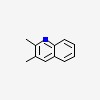 3D/inchi 3D/inchi
|
| ECHA EINECS - REACH Pre-Reg: | 217-016-0 | |
| Nikkaji Web: | J28.301K | |
| MDL: | MFCD03085977 | |
| XlogP3-AA: | 3.00 (est) | |
| Molecular Weight: | 157.21567000 | |
| Formula: | C11 H11 N | |
| NMR Predictor: | Predict (works with chrome or firefox) | |
Category: information only not used for fragrances or flavors
US / EU / FDA / JECFA / FEMA / FLAVIS / Scholar / Patent Information:
| Google Scholar: | Search |
| Google Books: | Search |
| Google Scholar: with word "volatile" | Search |
| Google Scholar: with word "flavor" | Search |
| Google Scholar: with word "odor" | Search |
| Google Patents: | Search |
| US Patents: | Search |
| EU Patents: | Search |
| Pubchem Patents: | Search |
| PubMed: | Search |
| NCBI: | Search |
Physical Properties:
| Assay: | 95.00 to 100.00 % |
| Food Chemicals Codex Listed: | No |
| Melting Point: | 68.50 °C. @ 760.00 mm Hg |
| Boiling Point: | 263.00 °C. @ 760.00 mm Hg |
| Vapor Pressure: | 0.013000 mmHg @ 25.00 °C. (est) |
| Flash Point: | 229.00 °F. TCC ( 109.70 °C. ) (est) |
| logP (o/w): | 2.935 (est) |
| Soluble in: | |
| water, 121.2 mg/L @ 25 °C (est) | |
Organoleptic Properties:
| Odor and/or flavor descriptions from others (if found). | |
Cosmetic Information:
| None found |
Suppliers:
| BOC Sciences |
| For experimental / research use only. |
| 2,3-Dimethylquinoline |
Safety Information:
| Hazards identification | |
| Classification of the substance or mixture | |
| GHS Classification in accordance with 29 CFR 1910 (OSHA HCS) | |
| None found. | |
| GHS Label elements, including precautionary statements | |
| Pictogram | |
| Hazard statement(s) | |
| None found. | |
| Precautionary statement(s) | |
| None found. | |
| Oral/Parenteral Toxicity: | |
| Not determined | |
| Dermal Toxicity: | |
| Not determined | |
| Inhalation Toxicity: | |
| Not determined | |
Safety in Use Information:
| Category: | information only not used for fragrances or flavors | ||
| Recommendation for 2,3-dimethyl quinoline usage levels up to: | |||
| not for fragrance use. | |||
| Recommendation for 2,3-dimethyl quinoline flavor usage levels up to: | |||
| not for flavor use. | |||
Safety References:
| EPI System: | View |
| AIDS Citations: | Search |
| Cancer Citations: | Search |
| Toxicology Citations: | Search |
| EPA ACToR: | Toxicology Data |
| EPA Substance Registry Services (SRS): | Registry |
| Laboratory Chemical Safety Summary : | 15591 |
| National Institute of Allergy and Infectious Diseases: | Data |
| 2,3-dimethylquinoline | |
| Chemidplus: | 0001721897 |
References:
| 2,3-dimethylquinoline | |
| NIST Chemistry WebBook: | Search Inchi |
| Pubchem (cid): | 15591 |
| Pubchem (sid): | 134980031 |
| Pherobase: | View |
Other Information:
| (IUPAC): | Atomic Weights of the Elements 2011 (pdf) |
| Videos: | The Periodic Table of Videos |
| tgsc: | Atomic Weights use for this web site |
| (IUPAC): | Periodic Table of the Elements |
| HMDB (The Human Metabolome Database): | Search |
| ChemSpider: | View |
Potential Blenders and core components note
| None Found | ||
Potential Uses:
| None Found |
Occurrence (nature, food, other): note
| not found in nature |
Synonyms:
| 2,3- | dimethylquinoline |
| quinoline, 2,3-dimethyl- |