|
Category: plasticizers
US / EU / FDA / JECFA / FEMA / FLAVIS / Scholar / Patent Information:
Physical Properties:
| Assay: | 95.00 to 100.00 %
|
| Food Chemicals Codex Listed: | No |
| Refractive Index: | 1.44230 @ 20.00 °C.
|
| Boiling Point: | 253.00 to 254.00 °C. @ 760.00 mm Hg
|
| Vapor Pressure: | 0.004000 mmHg @ 25.00 °C. (est) |
| Flash Point: | 185.00 °F. TCC ( 85.10 °C. ) (est)
|
| logP (o/w): | 2.518 (est) |
| Soluble in: |
| | water, 321.5 mg/L @ 25 °C (est) |
Organoleptic Properties:
| |
| Odor and/or flavor descriptions from others (if found). |
| |
| |
Cosmetic Information:
Suppliers:
| BOC Sciences |
| For experimental / research use only. |
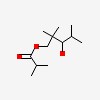
| 2,2,4-Trimethyl-1,3-pentanediol monoisobutyrate
|
| Eastman Chemical |
| Eastman Texanol™ Ester Alcohol
Odor: characteristic Use: Eastman Texanol™ ester alcohol is the premier coalescent for latex paints. It performs well in all types of latex paints, in a variety of weather conditions, and over substrates with different levels of porosity. Eastman Texanol™ ester alcohol provides the highest level of film integrity at low levels of coalescent, enhancing the performance properties of the paint including low temperature coalescence, touch-up, scrub resistance, washability, color development, thermal flexibility, and resistance to mudcracking. Eastman Texanol™; ester alcohol also enhances thickening efficiency when used with associative thickeners. |
| Sigma-Aldrich |
| For experimental / research use only. |
| 2,2,4-Trimethyl-1,3-pentanediol monoisobutyrate mixture of isomers, 99%
|
Safety Information:
| |
| Hazards identification |
| |
| Classification of the substance or mixture |
| GHS Classification in accordance with 29 CFR 1910 (OSHA HCS) |
| None found. |
| GHS Label elements, including precautionary statements |
| |
| Pictogram | |
| |
| Hazard statement(s) |
| None found. |
| Precautionary statement(s) |
| None found. |
| Oral/Parenteral Toxicity: |
oral-rat LD50 3200 mg/kg
Kodak Company Reports. Vol. M-158E, Pg. 1981
oral-mouse LD50 3200 mg/kg
Kodak Company Reports. Vol. M-158E, Pg. 1981
|
| Dermal Toxicity: |
skin-guinea pig LD50 > 20 ml/kg
Kodak Company Reports. Vol. M-158E, Pg. 1981
|
| Inhalation Toxicity: |
inhalation-rat LC > 3500 mg/m3/6H
Kodak Company Reports. Vol. 21MAY1971
|
Safety in Use Information:
| Category: | plasticizers |
| Recommendation for trimethyl hydroxypentyl isobutyrate usage levels up to: | | | not for fragrance use.
|
| |
| Recommendation for trimethyl hydroxypentyl isobutyrate flavor usage levels up to: |
| | not for flavor use.
|
Safety References:
References:
Other Information:
Potential Blenders and core components notePotential Uses:
Occurrence (nature, food, other): noteSynonyms:
| iso | butyric acid monoester with 2,2,4-trimethyl pentane-1,3-diol | | iso | butyric acid, ester with 2,2,4-trimethyl-1,3-pentanediol (7CI) | | iso | butyric acid, monoester with 2,2,4-trimethylpentane-1,3-diol | | 3- | hydroxy-2,2,4-trimethylpentyl 2-methylpropanoate | | 3- | hydroxy-2,2,4-trimethylpentyl isobutyrate | | (3- | hydroxy-2,2,4-trimethylpentyl) 2-methylpropanoate | | 1,3- | pentanediol, 2,2,4-trimethyl-, 1-isobutyrate | | 1,3- | pentanediol, 2,2,4-trimethyl-, monoisobutyrate | | | propanoic acid, 2-methyl-, 3-hydroxy-2,2,4-trimethylpentyl ester | | | propanoic acid, 2-methyl-, monoester with 2,2,4-trimethyl-1,3-pentanediol | | | propanoic acid, methyl-, monoester with 2,2,4-trimethyl-1,3-pentanediol | | | propionic acid, 2-methyl-, monoester with 2,2,4-trimethyl-1,3-pentanediol | | | texanol | | 2,2,4- | trimethyl-1,3-pentanediol 1-isobutyrate | | 2,2,4- | trimethyl-1,3-pentanediol 1-monoisobutyrate | | 2,2,4- | trimethyl-1,3-pentanediol monoisobutyrate | | 2,2,4- | trimethyl-1,3-pentanediolmono(2-methylpropanoate) | | 2,2,4- | trimethylpentane-1,3-diol monoisobutyrate |
Articles:
|

 3D/inchi