|
Category: pharmaceuticals / chemical synthisis
US / EU / FDA / JECFA / FEMA / FLAVIS / Scholar / Patent Information:
Physical Properties:
| Assay: | 95.00 to 100.00 %
|
| Food Chemicals Codex Listed: | No |
| Specific Gravity: | 0.96200 @ 25.00 °C.
|
| Boiling Point: | 183.16 °C. @ 760.00 mm Hg (est)
|
| Vapor Pressure: | 0.782000 mmHg @ 25.00 °C. (est) |
| Flash Point: | 161.00 °F. TCC ( 71.67 °C. )
|
| logP (o/w): | -0.144 (est) |
| Soluble in: |
| | water, 1.52e+005 mg/L @ 25 °C (est) |
Organoleptic Properties:
| |
| Odor and/or flavor descriptions from others (if found). |
| |
| |
Cosmetic Information:
Suppliers:
| BOC Sciences |
| For experimental / research use only. |
| N,N-Dimethylacrylamide 95%
|
| Connect Chemicals |
| N,N-dimethylacrylamide (NNDMAA)
|
| Jarchem Industries |
| Jarchem® NNDMA
Odor: characteristic Use: A water soluble monofunctional substituted acrylamide monomer offering superior glass and polycarbonate adhesion, increased hydrolytic stability, and excellent optical properties. Improves hydrolytic resistance in water soluble polymers. Good viscosity modifier for hydrophilic formulations. Improves adhesive properties in oligomers. Improves adhesion, UV and impact resistance. Applications include adhesives, UV coatings, inks , paints and conductive coatings, flocculant oil recovery polymers, water treatment, optical products, photoresists, and personal care polymers. |
| Kowa Amerian Corporation |
| DMAA
Odor: characteristic Use: DMAA is a high purity substance that is soluble in water. This material has a low vapor pressure and evaporates very slowly. |
| Santa Cruz Biotechnology |
| For experimental / research use only. |
| N,N-Dimethylacrylamide
|
| Sigma-Aldrich: Aldrich |
| For experimental / research use only. |
| N,N-Dimethylacrylamide 99%
contains 500 ppm monomethyl ether hydroquinone as inhibitor |
| TCI AMERICA |
| For experimental / research use only. |
| N,N-Dimethylacrylamide (stabilized with MEHQ) >99.0%(GC)
|
Safety Information:
| Preferred SDS: View |
| |
| Hazards identification |
| |
| Classification of the substance or mixture |
| GHS Classification in accordance with 29 CFR 1910 (OSHA HCS) |
| None found. |
| GHS Label elements, including precautionary statements |
| |
| Pictogram | |
| |
| Hazard statement(s) |
| None found. |
| Precautionary statement(s) |
| None found. |
| Oral/Parenteral Toxicity: |
oral-mouse LD50 460 mg/kg
BEHAVIORAL: MUSCLE WEAKNESS
BEHAVIORAL: IRRITABILITY
BEHAVIORAL: ALTERED SLEEP TIME (INCLUDING CHANGE IN RIGHTING REFLEX)
Eisei Kagaku. Hygienic Chemistry. Vol. 20, Pg. 317, 1974.
oral-rat LD50 316 mg/kg
SENSE ORGANS AND SPECIAL SENSES: PTOSIS: EYE
BEHAVIORAL: ATAXIA
BEHAVIORAL: SOMNOLENCE (GENERAL DEPRESSED ACTIVITY)
National Technical Information Service. Vol. OTS0555555
|
| Dermal Toxicity: |
subcutaneous-mouse LD50 580 mg/kg
BEHAVIORAL: ALTERED SLEEP TIME (INCLUDING CHANGE IN RIGHTING REFLEX)
BEHAVIORAL: IRRITABILITY
BEHAVIORAL: MUSCLE WEAKNESS
Eisei Kagaku. Hygienic Chemistry. Vol. 20, Pg. 317, 1974.
skin-rabbit LD50 540 uL/kg
LIVER: OTHER CHANGES
BEHAVIORAL: TREMOR
BEHAVIORAL: SOMNOLENCE (GENERAL DEPRESSED ACTIVITY)
National Technical Information Service. Vol. OTS0541042
|
| Inhalation Toxicity: |
inhalation-rat LC50 > 776 ppm/1H
LUNGS, THORAX, OR RESPIRATION: OTHER CHANGES
LUNGS, THORAX, OR RESPIRATION: "FIBROSIS, FOCAL (PNEUMOCONIOSIS)"
National Technical Information Service. Vol. OTS0559646
|
Safety in Use Information:
| Category: | pharmaceuticals / chemical synthisis |
| Recommendation for N,N-dimethyl acryl amide usage levels up to: | | | not for fragrance use.
|
| |
| Recommendation for N,N-dimethyl acryl amide flavor usage levels up to: |
| | not for flavor use.
|
Safety References:
References:
Other Information:
Potential Blenders and core components notePotential Uses:
Occurrence (nature, food, other): noteSynonyms:
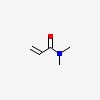
| | acrylamide, N,N-dimethyl- | | N,N- | dimethyl-2-propenamide | | N,N- | dimethylacrylamide | | N,N- | dimethylprop-2-enamide | | N,N- | dimethylpropenamide | | 2- | propenamide, N,N-dimethyl- |
Articles:
|


 3D/inchi