Articles:
(2R,3S)-butane-1,2,3,4-tetrol
Notes:
a four-carbon sugar that is found in algae, fungi, and lichens. it is twice as sweet as sucrose and can be used as a coronary vasodilator.

-
American International Chemical, Inc. Consistent sources North American supplier for globally sourced ingredients. AIC is a Westborough, MA based ISO Certified sales and marketing company serving the food, pharmaceutical, nutritional, personal care, biotech, and industrial markets of North America since 1972. Our success is a result of a company culture built on customer needs, along with partnerships with global manufacturers committed to the rigors and demands of the North American market. Our team of Sales Representatives, along with our network of strategically located warehouses are ready to supply product when and where you need it. Email: Info Voice: (800) 238-0001 Facebook Twitter Linkedin Products List: View Product(s): ERTJFP ERYTHRITOL FCC
-

-
BOC Sciences Best of Chemicals Supplier Quality supplier of research chemicals and biochemicals including inhibitors, building blocks, GMP Products, impurities and metabolites, APIs for Veterinary, Natural Compounds, ADCs, Stem Cell Molecule and chiral compounds. BOC Sciences provides a wide range of services to support the pharmaceutical industry through all stages of drug discovery including Custom Synthesis of those chemicals that are not in stock, Isotope Labeling Service, Chiral Synthesis and Resolution, Bioconjugation, PEGylation services, analytical services. BOC Sciences is a brand of BOCSCI Inc. We leverage our wide spectrum of business in the fields of development, manufacturing, marketing, and distribution to help you make best-informed decisions tailored to your evolving needs for premium chemicals. Our complete suite of CRO services spans the entire molecule development pipeline including contract research for target identification, building blocks, compound synthesis, biochemical and cellular analysis, preclinical animal tests, and clinical studies. Email: Marketing US Email: Marketing Email: Sales US Email: Sales Voice: 1-631-485-4226 Fax: 1-631-614-7828 US Voice: 1-631-485-4226 US Fax: 1-631-614-7828 Europe 44-203-286-1088 Facebook Twitter Linkedin Blog Get the App! Product(s): 149-32-6 meso-Erythritol
-

-
ECSA Chemicals Human Chemistry ECSA Chemicals has been active since 1913 in the trading and international commerce of raw materials. With an organisation divided into industrial segments managed by specialists, it has become one of the largest distributors worldwide. ECSA Chemicals is the largest Swiss-owned company in terms of warehouses for the distribution of chemical products. We have been distributing chemical products for over 100 years and we have a special interest in protecting the environment and in the safety of our facilities and collaborators. Established in 1913 as a small grocery store, in its over 100 years of activity ECSA Chemicals has become one of the most important Swiss-owned distributors of chemical products. The company, which is active in international distribution and trading, is organised into industrial segments that are managed by teams of specialists and experts. They guarantee professional and customised consultancy and services. With our experience, we can rapidly and safely connect you with the best suppliers on the market, providing you with a complete search, consulting and assistance service. The focus of our approach and operations is you, our customers. We strive every day to find the best products that satisfy your needs as quickly as possible. Your satisfaction is our greatest success. WHY CHOOSE ECSA? EXPERIENCE We have been working for 100 years. QUALITY We have obtained many certifications (ISO, SQAS, GDP, Responsible Care, Bio-Inspecta, RSPO, etc.). We guarantee full compliance with the current laws and continuous training for our staff. SAFETY We constantly carry out risk analyses for each infrastructure, defining safety levels and implementing corrective measures promptly wherever they are needed. WIDESPREAD DISTRIBUTION We have warehouses in strategic locations to supply goods to Switzerland and to the rest of the world. STORAGE CAPACITY The 3 ECSA-owned warehouses guarantee considerable storage area and capacity in each warehouse, with full availability of products (base chemicals and speciality chemicals). SPEED Presence all over the country, staff dedicated to sourcing raw materials and considerable storage capacity guarantee that goods are rapidly obtained and supplied. CONSULTANCY Our specialists - in-depth knowledge of the market and products allows us to provide full consulting services, from the purchase to the supply of raw materials. Email: Info Email: Sales Email: Trading Email: Maintenance Email: Energy Voice: +41 91 695 88 00 Fax: +41 91 695 88 01 Linkedin Youtube RSS Feed ECSA Trade ECSA TRADE THE MOST UPDATED FINANCIAL PUBLICATION ON THE WORLD OF CHEMISTRY Products List: View Product(s): MP-027581 ERYTHRITOL
-

-
Glentham Life Sciences Ltd The Chemical, Biochemical & Research Essentials Supplier Glentham Life Sciences is a supplier of fine chemicals and raw materials with warehousing, laboratories and packaging facilities in the UK. With a Glentham Life Sciences account you can view more product details, request quotes and order products online. Email: Info Email: Sales Email: Tech Support Voice: +44 (0) 1225 667798 Fax: +44 (0) 2033 978909 Facebook Twitter Linkedin Google+ News Distribution Products List: View Product(s): GC1722 meso-Erythritol
-

-
Jiangyin Healthway International Trade Co., Ltd Independent Ingredients Supplier We provide custom synthesis and contract manufacturing from milligrams to metric tonnes. Jiangyin Healthway International Trade Co., Ltd is a professional company, main engaged in manufacturing and exporting aroma chemicals ,food additives , cosmetic ingredient ,pharmaceutical intermediates & other fine chemicals; especially on aroma chemicals , as the major manufacturer of heterocyclic and sulphur aroma compounds , we are the leading independent ingredients supplier to the flavour and fragrance industries in China, can offer hundreds of different high quality aroma chemicals. Email: Info Email: Sales Voice: 86-510-86023169 Fax: 86-510-86023170 Mobile 0086-13093133011 Services Biochemical Natural Food Colour New functional food ingredients Product(s): HLCFD-192 Erythritol
-

-
O'Laughlin Industries Inc. Manufacturer of chemicals and ingredients used in flavors, fragrances, food, beverages and cosmetics Leading the Flavor and Fragrance Industry since 1980. O'Laughlin was established in 1980 by its owner and chief executive Michael O'Laughlin, when he moved to Beijing, China and established a small office. Since then it has grown to be a world class producer of chemicals, with significant production facilities in China, and distribution and sales in all major world markets. Email: Sales US Email: John Gick Voice: (852) 2527-1031 Fax: (852) 2529-0231 US Voice: (973) 376-4600 US Fax: (973) 376-4630 Product(s): 775-2017 Erythritol, FCC 775-2018 ERYTHRITOL/ STEVIA CO-CRYSTALLIZED BLEND 775-2019 ERYTHRITOL/ STEVIA CO-CRYSTALLIZED BLEND 775-2020 Erythritol /Stevia agglomerated blend 5 to 1 sugar sweetness 775-2021 Erythritol /Stevia agglomerated blend 10 to 1 sugar sweetness
-

-
Penta International Corporation Chemistry innovation At Penta, our products and services help businesses do business better. For over 30 years, Penta Manufacturing Company has played a growing role in worldwide chemistry innovations and applications. As an industry leader, Penta continues to pioneer chemistry-based solutions for practically every area of commerce. Our products and expertise have helped fuel technical advances in dozens of commercial applications including flavoring, coloring, fragrances and chemical processes. US Email: Technical Services US Email: Sales US Voice: (973) 740-2300 US Fax: (973) 740-1839 Product(s): 05-05800 meso-ERYTHRITOL
-

-
TCI AMERICA Moving Your Chemistry Forward We continuously strive to advance our technology. With East & West Coast distribution centers, count on TCI to deliver products quickly and reliably. Over 30,000 Reagents available today in benchtop to bulk quantities. We also offer custom synthesis solutions. Sign up for a TCI account today for fast and free shipping! Tokyo Chemical Industry Co., Ltd. (TCI) is a leading worldwide manufacturer of specialty organic chemicals founded in 1946. TCI provides organic laboratory chemicals as well as pharmaceutical, cosmetic and functional materials. More than 70 years of synthesis experience and multi-purpose plants enable TCI to offer more than 30,000 products as well as custom synthesis. US Email: Sales Email: Technical Support Voice: 1-800-423-8616 Fax: 1- 888-520-1075 Facebook Twitter Instagram Linkedin Product(s): E0021 meso-Erythritol >99.0%(HPLC)(T)
-

-
Qingdao Free Trade Zone United International Co Ltd Quality Products A partner in your supply chain solution. Qingdao Free Trade Zone United International Trade Co., Ltd.was founded in 1996, specializing in the production and import and export of food additives,flavor raw materials and pharmaceutical and chemical raw materials. The company has experienced R&D and business personnel,product quality, low price, efficient service and fast insight and grasp the latest market information. Email: Info Email: Sales Voice: +86-532-83893699 Fax: +86-532-83893695 Product(s): 7220 Erythritol
-
| CAS Number: | 149-32-6 | 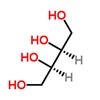 3D/inchi 3D/inchi
|
| Other(deleted CASRN): | 10030-58-7 | |
| ECHA EINECS - REACH Pre-Reg: | 205-737-3 | |
| FDA UNII: | RA96B954X6 | |
| Nikkaji Web: | J43.360H | |
| Beilstein Number: | 1719753 | |
| MDL: | MFCD00004710 | |
| XlogP3: | -2.30 (est) | |
| Molecular Weight: | 122.12050000 | |
| Formula: | C4 H10 O4 | |
| BioActivity Summary: | listing | |
| NMR Predictor: | Predict (works with chrome or firefox) | |
Category: flavor enhancers, humectants, carriers, sweeteners
US / EU / FDA / JECFA / FEMA / FLAVIS / Scholar / Patent Information:
| Google Scholar: | Search |
| Google Books: | Search |
| Google Scholar: with word "volatile" | Search |
| Google Scholar: with word "flavor" | Search |
| Google Scholar: with word "odor" | Search |
| Perfumer and Flavorist: | Search |
| Google Patents: | Search |
| US Patents: | Search |
| EU Patents: | Search |
| Pubchem Patents: | Search |
| PubMed: | Search |
| NCBI: | Search |
| FDA/DG SANTE Petitions, Reviews, Notices: | |
| GRN 401 7 | Erythritol View - notice PDF |
| GRN 382 | Erythritol View - notice PDF |
| GRN 76 | Erythritol View - notice PDF |
| GRN 208 | Erythritol View - notice PDF |
| GRN 789 | Erythritol View - notice PDF |
| JECFA Food Additive: | Erythritol |
| FEMA Number: | 4819 meso-erythritol |
| FDA: | No longer provide for the use of these seven synthetic flavoring substances |
Physical Properties:
| Appearance: | white crystalline powder (est) |
| Assay: | 99.00 to 100.00 % |
| Food Chemicals Codex Listed: | No |
| Melting Point: | 119.00 to 123.00 °C. @ 760.00 mm Hg |
| Boiling Point: | 330.00 to 331.00 °C. @ 760.00 mm Hg |
| Flash Point: | 408.00 °F. TCC ( 208.70 °C. ) (est) |
| logP (o/w): | -2.996 (est) |
| Soluble in: | |
| water, 6.10E+05 mg/L @ 22 °C (exp) | |
| alcohol, slightly | |
| Insoluble in: | |
| diethyl ether | |
Organoleptic Properties:
| Odor Description: at 100.00 %. | odorless |
| Odor and/or flavor descriptions from others (if found). | |
Cosmetic Information:
| None found |
Suppliers:
| American International Chemical, LLC. |
| ERYTHRITOL FCC |
| Atlantic Chemicals |
| Erythritol |
| BOC Sciences |
| For experimental / research use only. |
| meso-Erythritol |
| Carbosynth |
| For experimental / research use only. |
| meso-Erythritol |
| Cargill, Inc. |
| Zerose® erythritol
Flavor: characteristic Erythritol, a natural, zero calorie, high digestive tolerance polyol, provides bulk, texture, high cooling effect and preservative benefits of sucrose in sugar-free and calorie-reduced products. Erythritol is suitable for dental health, weight management and sugar avoiders. |
| Coompo |
| For experimental / research use only. |
| Erythritol from Plants ≥96% |
| ECSA Chemicals |
| ERYTHRITOL |
| ECSA TRADE THE MOST UPDATED FINANCIAL PUBLICATION ON THE WORLD OF CHEMISTRY |
| ExtraSynthese |
| For experimental / research use only. |
| meso-Erythritol |
| Foodchem International |
| Erythritol |
| Glentham Life Sciences |
| meso-Erythritol |
| Jiangyin Healthway |
| Erythritol |
| New functional food ingredients |
| Jungbunzlauer Suisse |
| ERYLITE®
Flavor: sweet ERYLITE® is a novel bulk sweetener with a caloric value close to zero. Chemically, it is a four-carbon sugar alcohol (polyol). ERYLITE® is produced by microbial fermentation of a carbohydrate substrate. It is the only all-natural sugar alcohol available today. |
| Kraft Chemical |
| Erythritol |
| O'Laughlin Industries |
| Erythritol /Stevia agglomerated blend
10 to 1 sugar sweetness |
| O'Laughlin Industries |
| Erythritol /Stevia agglomerated blend
5 to 1 sugar sweetness |
| O'Laughlin Industries |
| Erythritol, FCC |
| O'Laughlin Industries |
| ERYTHRITOL/ STEVIA CO-CRYSTALLIZED BLEND |
| O'Laughlin Industries |
| ERYTHRITOL/ STEVIA CO-CRYSTALLIZED BLEND |
| Penta International |
| meso-ERYTHRITOL |
| Prinova |
| Erythritol FCC |
| Santa Cruz Biotechnology |
| For experimental / research use only. |
| meso-Erythritol ≥98% |
| Sigma-Aldrich: Sigma |
| For experimental / research use only. |
| meso-Erythritol ≥99% |
| Sinofi Food Ingredients |
| Erythritol
Flavor: characteristic Sugar Substitutes, Chewing Gum, Beverages, Confections, Baking Food, Chocolate, Instant Coffee, Ice Cream. |
| TCI AMERICA |
| For experimental / research use only. |
| meso-Erythritol >99.0%(HPLC)(T) |
| United International |
| Erythritol |
| Viachem |
| Erythritol
Odor: bland Use: Erythritol, C4H10O4, is a novel bulk sweetener with a caloric value close to zero. Chemically, it is a four-carbon sugar alcohol (polyol). Erythritol, a white crystalline powder, is made through fermentation. |
Safety Information:
| Preferred SDS: View | |
| Hazards identification | |
| Classification of the substance or mixture | |
| GHS Classification in accordance with 29 CFR 1910 (OSHA HCS) | |
| None found. | |
| GHS Label elements, including precautionary statements | |
| Pictogram | |
| Hazard statement(s) | |
| None found. | |
| Precautionary statement(s) | |
| None found. | |
| Oral/Parenteral Toxicity: | |
|
intraperitoneal-mouse LD50 7000 mg/kg Proceedings of the Society for Experimental Biology and Medicine. Vol. 35, Pg. 98, 1936. intravenous-dog LDLo 5000 mg/kg "Merck Index; an Encyclopedia of Chemicals, Drugs, and Biologicals", 11th ed., Rahway, NJ 07065, Merck & Co., Inc. 1989Vol. 11, Pg. 576, 1989. | |
| Dermal Toxicity: | |
| Not determined | |
| Inhalation Toxicity: | |
| Not determined | |
Safety in Use Information:
| Category: | flavor enhancers, humectants, carriers, sweeteners | ||
| Recommendation for meso-erythritol usage levels up to: | |||
| not for fragrance use. | |||
| Use levels for FEMA GRAS flavoring substances on which the FEMA Expert Panel based its judgments that the substances are generally recognized as safe (GRAS). | |||
| The Expert Panel also publishes separate extensive reviews of scientific information on all FEMA GRAS flavoring substances and can be found at FEMA Flavor Ingredient Library | |||
| publication number: 28. Update in publication number(s): 29 | |||
| Click here to view publication 28 | |||
| average usual ppm | average maximum ppm | ||
| baked goods: | - | - | |
| beverages(nonalcoholic): | 5000.00000 | 12500.00000 | |
| beverages(alcoholic): | 5000.00000 | 12500.00000 | |
| breakfast cereal: | 12500.00000 | 17500.00000 | |
| cheese: | - | - | |
| chewing gum: | - | - | |
| condiments / relishes: | - | - | |
| confectionery froastings: | - | - | |
| egg products: | - | - | |
| fats / oils: | - | - | |
| fish products: | - | - | |
| frozen dairy: | 12500.00000 | 17500.00000 | |
| fruit ices: | 5000.00000 | 12500.00000 | |
| gelatins / puddings: | - | - | |
| granulated sugar: | - | - | |
| gravies: | - | - | |
| hard candy: | - | - | |
| imitation dairy: | 12500.00000 | 17500.00000 | |
| instant coffee / tea: | 5000.00000 | 12500.00000 | |
| jams / jellies: | - | - | |
| meat products: | - | - | |
| milk products: | 12500.00000 | 17500.00000 | |
| nut products: | 12500.00000 | 17500.00000 | |
| other grains: | 12500.00000 | 17500.00000 | |
| poultry: | - | - | |
| processed fruits: | 5000.00000 | 12500.00000 | |
| processed vegetables: | - | - | |
| reconstituted vegetables: | - | - | |
| seasonings / flavors: | - | - | |
| snack foods: | - | - | |
| soft candy: | - | - | |
| soups: | - | - | |
| sugar substitutes: | - | - | |
| sweet sauces: | - | - | |
Safety References:
| European Food Safety Authority (EFSA) reference(s): | |
| Statement in relation to the safety of erythritol (E 968) in light of new data, including a new paediatric study on the gastrointestinal tolerability of erythritol View page or View pdf | |
| ment on a refined dietary exposure assessment of erythritol (E 968) taking into account additional data provided View page or View pdf | |
| Scientific Opinion on the safety of the proposed extension of use of erythritol (E 968) as a food additive View page or View pdf | |
| Sugar-free hard confectionery with at least 90% erythritol and reduction of dental plaque which reduces the risk of dental caries: evaluation of a health claim pursuant to Article 14 of Regulation (EC) No 1924/2006 View page or View pdf | |
| Outcome of the public consultation on a draft protocol for assessing exposure to sweeteners as part of their safety assessment under the food additives re-evaluation programme View page or View pdf | |
| EPI System: | View |
| ClinicalTrials.gov: | search |
| Daily Med: | search |
| Chemical Carcinogenesis Research Information System: | Search |
| AIDS Citations: | Search |
| Cancer Citations: | Search |
| Toxicology Citations: | Search |
| EPA Substance Registry Services (TSCA): | 149-32-6 |
| EPA ACToR: | Toxicology Data |
| EPA Substance Registry Services (SRS): | Registry |
| Laboratory Chemical Safety Summary : | 222285 |
| National Institute of Allergy and Infectious Diseases: | Data |
| WGK Germany: | 3 |
| (2R,3S)-butane-1,2,3,4-tetrol | |
| Chemidplus: | 0000149326 |
| RTECS: | KF2000000 for cas# 149-32-6 |
References:
| (2R,3S)-butane-1,2,3,4-tetrol | |
| NIST Chemistry WebBook: | Search Inchi |
| Canada Domestic Sub. List: | 149-32-6 |
| Pubchem (cid): | 222285 |
| Pubchem (sid): | 134975586 |
Other Information:
| (IUPAC): | Atomic Weights of the Elements 2011 (pdf) |
| Videos: | The Periodic Table of Videos |
| tgsc: | Atomic Weights use for this web site |
| (IUPAC): | Periodic Table of the Elements |
| CHEBI: | View |
| CHEMBL: | View |
| Golm Metabolome Database: | Search |
| Metabolomics Database: | Search |
| KEGG (GenomeNet): | C00503 |
| HMDB (The Human Metabolome Database): | HMDB02994 |
| Export Tariff Code: | 2940.00.6000 |
| FDA Listing of Food Additive Status: | View |
| VCF-Online: | VCF Volatile Compounds in Food |
| ChemSpider: | View |
| Wikipedia: | View |
| FAO: | ERYTHRITOL |
Potential Blenders and core components note
| None Found | ||
Potential Uses:
| None Found |
Occurrence (nature, food, other): note
| algae Search PMC Picture |
Synonyms:
| antierythrite | |
| (R*,S*)-1,2,3,4- | butane tetrol |
| (2R,3S)- | butane-1,2,3,4-tetraol |
| (2R,3S)- | butane-1,2,3,4-tetrol |
| meso- | butane-1,2,3,4-tetrol |
| (2R,3S)-1,2,3,4- | butanetetrol |
| (R*,R*)-1,2,3,4- | butanetetrol |
| DL-1,2,3,4- | butanetetrol |
| 1,2,3,4- | butanetetrol, (2R,3S)- |
| (2R,3S)-1,2,3,4- | butantetrol |
| erythrite | |
| (R*,S*)- | tetrahydroxybutane |
| DL- | threitol |