|
Category: information only not used for fragrances or flavors
US / EU / FDA / JECFA / FEMA / FLAVIS / Scholar / Patent Information:
Physical Properties:
| Appearance: | white powder (est) |
| Assay: | 95.00 to 100.00 %
|
| Food Chemicals Codex Listed: | No |
| Melting Point: | 281.00 to 285.00 °C. @ 760.00 mm Hg
|
| Boiling Point: | 447.00 to 449.00 °C. @ 760.00 mm Hg
|
| Flash Point: | 437.00 °F. TCC ( 225.00 °C. )
|
| logP (o/w): | -1.154 (est) |
| Soluble in: |
| | water, 5000 mg/L @ 20 °C (exp) |
Organoleptic Properties:
| |
| Odor Type: odorless |
| |
| Odor Strength: | none |
| |
Odor Description:
at 100.00 %. | odorless |
| |
| |
| Flavor Type: sweet |
| |
| | sweet |
Taste Description:
| sweet |
| |
| Odor and/or flavor descriptions from others (if found). |
| |
| |
Cosmetic Information:
Suppliers:
Safety Information:
| Preferred SDS: View |
| European information : |
| Most important hazard(s): | | Xn - Harmful. |
R 22 - Harmful if swallowed.
R 36/37/38 - Irritating to eyes, respiratory system, and skin.
S 02 - Keep out of the reach of children.
S 20/21 - When using do not eat, drink or smoke.
S 24/25 - Avoid contact with skin and eyes.
S 26 - In case of contact with eyes, rinse immediately with plenty of water and seek medical advice.
S 36/37/39 - Wear suitable clothing, gloves and eye/face protection.
|
| |
| Hazards identification |
| |
| Classification of the substance or mixture |
| GHS Classification in accordance with 29 CFR 1910 (OSHA HCS) |
| None found. |
| GHS Label elements, including precautionary statements |
| |
| Pictogram | |
| |
| Hazard statement(s) |
| None found. |
| Precautionary statement(s) |
| None found. |
| Oral/Parenteral Toxicity: |
intravenous-mouse LD50 450 mg/kg
Toxicology and Applied Pharmacology. Vol. 28, Pg. 1, 1974.
oral-mouse LD50 2363 mg/kg
BEHAVIORAL: EXCITEMENT
Toxicology and Applied Pharmacology. Vol. 28, Pg. 1, 1974.
oral-rabbit LD50 609 mg/kg
Toxicology and Applied Pharmacology. Vol. 28, Pg. 1, 1974.
intraperitoneal-rat LD50 624 mg/kg
SKIN AND APPENDAGES (SKIN): HAIR: OTHER
BEHAVIORAL: EXCITEMENT
SENSE ORGANS AND SPECIAL SENSES: OTHER: EYE
Toxicology and Applied Pharmacology. Vol. 28, Pg. 1, 1974.
intravenous-rat LD50 > 100 mg/kg
Drugs in Japan Vol. 6, Pg. 905, 1982.
oral-bird - wild LD50 100 mg/kg
Archives of Environmental Contamination and Toxicology. Vol. 12, Pg. 355, 1983.
oral-human TDLo 13000 mg/kg/1Y
BEHAVIORAL: ATAXIA
LUNGS, THORAX, OR RESPIRATION: DYSPNEA
BEHAVIORAL: CHANGES IN MOTOR ACTIVITY (SPECIFIC ASSAY)
Journal of Neurology, Neurosurgery and Psychiatry. Vol. 34, Pg. 668, 1971.
oral-human TDLo 156000 mg/kg/10Y
BEHAVIORAL: SOMNOLENCE (GENERAL DEPRESSED ACTIVITY)
BEHAVIORAL: TOXIC PSYCHOSIS
BEHAVIORAL: "HALLUCINATIONS, DISTORTED PERCEPTIONS"
Journal of Neurology, Neurosurgery and Psychiatry. Vol. 34, Pg. 502, 1971.
intraperitoneal-mouse LD50 588 mg/kg
BEHAVIORAL: SOMNOLENCE (GENERAL DEPRESSED ACTIVITY)
LUNGS, THORAX, OR RESPIRATION: OTHER CHANGES
SENSE ORGANS AND SPECIAL SENSES: LACRIMATION: EYE
Toxicology and Applied Pharmacology. Vol. 28, Pg. 1, 1974.
unreported-mouse LDLo 3500 mg/kg
AUTONOMIC NERVOUS SYSTEM: SYMPATHOMIMETIC
Naunyn-Schmiedeberg's Archiv fuer Experimentelle Pathologie und Pharmakologie. Vol. 153, Pg. 161, 1930.
oral-rat LD50 1780 mg/kg
BEHAVIORAL: AGGRESSION
BEHAVIORAL: ATAXIA
BEHAVIORAL: EXCITEMENT
Toxicology and Applied Pharmacology. Vol. 28, Pg. 1, 1974.
|
| Dermal Toxicity: |
subcutaneous-mouse LD50 4449 mg/kg
BEHAVIORAL: CONVULSIONS OR EFFECT ON SEIZURE THRESHOLD
GASTROINTESTINAL: CHANGES IN STRUCTURE OR FUNCTION OF SALIVARY GLANDS
PERIPHERAL NERVE AND SENSATION: LOCAL ANESTHETIC
Iyakuhin Kenkyu. Study of Medical Supplies. Vol. 3, Pg. 186, 1972.
subcutaneous-rat LD50 2000 mg/kg
GASTROINTESTINAL: CHANGES IN STRUCTURE OR FUNCTION OF SALIVARY GLANDS
BEHAVIORAL: CONVULSIONS OR EFFECT ON SEIZURE THRESHOLD
LUNGS, THORAX, OR RESPIRATION: OTHER CHANGES
Iyakuhin Kenkyu. Study of Medical Supplies. Vol. 3, Pg. 186, 1972.
|
| Inhalation Toxicity: |
|
Not determined
|
Safety in Use Information:
| Category: | information only not used for fragrances or flavors |
| Recommendation for levodopa usage levels up to: | | | not for fragrance use.
|
| |
| Recommendation for levodopa flavor usage levels up to: |
| | not for flavor use.
|
Safety References:
References:
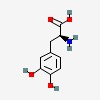
| | (2S)-2-amino-3-(3,4-dihydroxyphenyl)propanoic acid |
| NIST Chemistry WebBook: | Search Inchi |
| Pubchem (cid): | 6047 |
| Pubchem (sid): | 134972617 |
Other Information:
Potential Blenders and core components notePotential Uses:
Occurrence (nature, food, other): noteSynonyms:
| (2S)-2- | amino-3-(3,4-dihydroxyphenyl)propanoic acid | | (S)-2- | amino-3-(3,4-dihydroxyphenyl)propanoic acid | | 2- | amino-3-(3,4-dihydroxyphenyl)propanoic acid | | 3,4- | dihydroxy-L-phenylalanine | | 3,4- | dihydroxy-laevo-phenyl alanine | | L-3,4- | dihydroxyphenyl alanine | | laevo-3,4- | dihydroxyphenyl alanine | | 3,4- | dihydroxyphenyl-laevo-alanine | | L-3-(3,4- | dihydroxyphenyl) alanine | | laevo-3-(3,4- | dihydroxyphenyl) alanine | | L-beta-(3,4- | dihydroxyphenyl)-alpha-alanine | | laevo-beta-(3,4- | dihydroxyphenyl)-alpha-alanine | | 3-(3,4- | dihydroxyphenyl)-L-alanine | | beta-(3,4- | dihydroxyphenyl)-laevo-alanine | | 3,4-L- | dihydroxyphenylalanine | | L-3,4- | dihydroxyphenylalanine | | L- | dopa | | laevo- | dopa | | 3- | hydroxy-L-tyrosine | | 3- | hydroxy-laevo-tyrosine | | L- | tyrosine, 3-hydroxy- |
Articles:
|



 3D/inchi