Articles:
imidazole, 4-(2-aminoethyl)-
Notes:
an amine derived by enzymatic decarboxylation of histidine. it is a powerful stimulant of gastric secretion, a constrictor of bronchial smooth muscle, a vasodilator, and also a centrally acting neurotransmitter. An amine derived by enzymatic decarboxylation of histidine. It is a powerful stimulant of gastric secretion, a constrictor of bronchial smooth muscle, a vasodilator, and also a centrally acting neurotransmitter.; Histamine is a biogenic amine involved in local immune responses as well as regulating physiological function in the gut and acting as a neurotransmitter. Histamine triggers the inflammatory response. As part of an immune response to foreign pathogens, histamine is produced by basophils and by mast cells found in nearby connective tissues. Histamine increases the permeability of the capillaries to white blood cells and other proteins, in order to allow them to engage foreign invaders in the affected tissues. It is found in virtually all animal body cells.[citation needed]; Histamine is derived from the decarboxylation of the amino acid histidine, a reaction catalyzed by the enzyme L-histidine decarboxylase. It is a hydrophilic vasoactive amine.

-
BOC Sciences Best of Chemicals Supplier Quality supplier of research chemicals and biochemicals including inhibitors, building blocks, GMP Products, impurities and metabolites, APIs for Veterinary, Natural Compounds, ADCs, Stem Cell Molecule and chiral compounds. BOC Sciences provides a wide range of services to support the pharmaceutical industry through all stages of drug discovery including Custom Synthesis of those chemicals that are not in stock, Isotope Labeling Service, Chiral Synthesis and Resolution, Bioconjugation, PEGylation services, analytical services. BOC Sciences is a brand of BOCSCI Inc. We leverage our wide spectrum of business in the fields of development, manufacturing, marketing, and distribution to help you make best-informed decisions tailored to your evolving needs for premium chemicals. Our complete suite of CRO services spans the entire molecule development pipeline including contract research for target identification, building blocks, compound synthesis, biochemical and cellular analysis, preclinical animal tests, and clinical studies. Email: Marketing US Email: Marketing Email: Sales US Email: Sales Voice: 1-631-485-4226 Fax: 1-631-614-7828 US Voice: 1-631-485-4226 US Fax: 1-631-614-7828 Europe 44-203-286-1088 Facebook Twitter Linkedin Blog Get the App! Product(s): 51-45-6 Histamine ≥97% Histamine is an organic nitrogenous compound produced by basophils and by mast cells found in nearby connective tissues. An organic nitrogenous compound
-

-
Glentham Life Sciences Ltd The Chemical, Biochemical & Research Essentials Supplier Glentham Life Sciences is a supplier of fine chemicals and raw materials with warehousing, laboratories and packaging facilities in the UK. With a Glentham Life Sciences account you can view more product details, request quotes and order products online. Email: Info Email: Sales Email: Tech Support Voice: +44 (0) 1225 667798 Fax: +44 (0) 2033 978909 Facebook Twitter Linkedin Google+ News Distribution Products List: View Product(s): GL9196 Histamine
-
| CAS Number: | 51-45-6 | 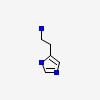 3D/inchi 3D/inchi
|
| Other(deleted CASRN): | 64422-25-9 | |
| ECHA EINECS - REACH Pre-Reg: | 200-100-6 | |
| FDA UNII: | 820484N8I3 | |
| Nikkaji Web: | J4.117C | |
| Beilstein Number: | 0002012 | |
| MDL: | MFCD00005210 | |
| XlogP3: | -0.70 (est) | |
| Molecular Weight: | 111.14773000 | |
| Formula: | C5 H9 N3 | |
| BioActivity Summary: | listing | |
| NMR Predictor: | Predict (works with chrome or firefox) | |
Category: natural substances and extractives
US / EU / FDA / JECFA / FEMA / FLAVIS / Scholar / Patent Information:
| Google Scholar: | Search |
| Google Books: | Search |
| Google Scholar: with word "volatile" | Search |
| Google Scholar: with word "flavor" | Search |
| Google Scholar: with word "odor" | Search |
| Google Patents: | Search |
| US Patents: | Search |
| EU Patents: | Search |
| Pubchem Patents: | Search |
| PubMed: | Search |
| NCBI: | Search |
Physical Properties:
| Appearance: | white needles (est) |
| Assay: | 95.00 to 100.00 % |
| Food Chemicals Codex Listed: | No |
| Melting Point: | 86.00 °C. @ 760.00 mm Hg |
| Boiling Point: | 380.29 °C. @ 760.00 mm Hg (est) |
| Flash Point: | 357.00 °F. TCC ( 180.30 °C. ) (est) |
| logP (o/w): | -0.700 |
| Soluble in: | |
| water, 1e+006 mg/L @ 25 °C (est) | |
Organoleptic Properties:
| Odor and/or flavor descriptions from others (if found). | |
Cosmetic Information:
| None found |
Suppliers:
| Alfa Biotechnology |
| For experimental / research use only. |
| Histamine 98% |
| BOC Sciences |
| For experimental / research use only. |
| Histamine ≥97%
Odor: characteristic Use: Histamine is an organic nitrogenous compound produced by basophils and by mast cells found in nearby connective tissues.
An organic nitrogenous compound |
| Glentham Life Sciences |
| Histamine |
| Santa Cruz Biotechnology |
| For experimental / research use only. |
| Histamine, free base ≥97% |
| Sigma-Aldrich: Sigma |
| For experimental / research use only. |
| Histamine ≥97.0% |
Safety Information:
| Preferred SDS: View | |
| Hazards identification | |
| Classification of the substance or mixture | |
| GHS Classification in accordance with 29 CFR 1910 (OSHA HCS) | |
| None found. | |
| GHS Label elements, including precautionary statements | |
| Pictogram | |
| Hazard statement(s) | |
| None found. | |
| Precautionary statement(s) | |
| None found. | |
| Oral/Parenteral Toxicity: | |
|
intravenous-dog LD50 7 mg/kg CARDIAC: OTHER CHANGES Indian Veterinary Journal. Vol. 57, Pg. 31, 1980. intraperitoneal-guinea pig LD50 5 mg/kg "Structure et Activite Pharmacodyanmique des Medicaments du Systeme Nerveux Vegetatif," Bovet, D., and F. Bovet-Nitti, New York, S. Karger, 1948Vol. -, Pg. 736, 1948. intravenous-guinea pig LD50 180 ug/kg Journal of Pharmacology and Experimental Therapeutics. Vol. 95, Pg. 45, 1949. oral-guinea pig LDLo 200 mg/kg LUNGS, THORAX, OR RESPIRATION: DYSPNEA "Structure et Activite Pharmacodyanmique des Medicaments du Systeme Nerveux Vegetatif," Bovet, D., and F. Bovet-Nitti, New York, S. Karger, 1948Vol. -, Pg. 718, 1948. intraperitoneal-mouse LD50 725 mg/kg British Journal of Pharmacology and Chemotherapy. Vol. 17, Pg. 137, 1961. intravenous-mouse LD50 385 mg/kg BEHAVIORAL: CONVULSIONS OR EFFECT ON SEIZURE THRESHOLD BEHAVIORAL: ATAXIA LUNGS, THORAX, OR RESPIRATION: OTHER CHANGES Kiso to Rinsho. Clinical Report. Vol. 13, Pg. 89, 1979. oral-mouse LD50 220 mg/kg Japanese Journal of Toxicology. Vol. 4, Pg. 105, 1991. intravenous-rabbit LDLo 2 mg/kg "Structure et Activite Pharmacodyanmique des Medicaments du Systeme Nerveux Vegetatif," Bovet, D., and F. Bovet-Nitti, New York, S. Karger, 1948Vol. -, Pg. 784, 1948. intravenous-rat LD50 630 mg/kg LUNGS, THORAX, OR RESPIRATION: OTHER CHANGES LUNGS, THORAX, OR RESPIRATION: DYSPNEA Kiso to Rinsho. Clinical Report. Vol. 13, Pg. 89, 1979. | |
| Dermal Toxicity: | |
|
subcutaneous-cat LDLo 34 mg/kg Naunyn-Schmiedeberg's Archiv fuer Experimentelle Pathologie und Pharmakologie. Vol. 185, Pg. 461, 1937. subcutaneous-dog LDLo 28500 ug/kg GASTROINTESTINAL: "HYPERMOTILITY, DIARRHEA" LUNGS, THORAX, OR RESPIRATION: DYSPNEA BEHAVIORAL: COMA "Structure et Activite Pharmacodyanmique des Medicaments du Systeme Nerveux Vegetatif," Bovet, D., and F. Bovet-Nitti, New York, S. Karger, 1948Vol. -, Pg. 718, 1948. subcutaneous-frog LDLo 1700 mg/kg "Structure et Activite Pharmacodyanmique des Medicaments du Systeme Nerveux Vegetatif," Bovet, D., and F. Bovet-Nitti, New York, S. Karger, 1948Vol. -, Pg. 718, 1948. subcutaneous-guinea pig LDLo 8 mg/kg Farmaco, Edizione Scientifica. Vol. 9, Pg. 379, 1954. subcutaneous-mouse LD50 2500 mg/kg BEHAVIORAL: ATAXIA BEHAVIORAL: CONVULSIONS OR EFFECT ON SEIZURE THRESHOLD LUNGS, THORAX, OR RESPIRATION: OTHER CHANGES Kiso to Rinsho. Clinical Report. Vol. 13, Pg. 89, 1979. subcutaneous-rabbit LDLo 12 mg/kg CARDIAC: PULSE RATE INCREASE WITHOUT FALL IN BP LUNGS, THORAX, OR RESPIRATION: RESPIRATORY STIMULATION BEHAVIORAL: ALTERED SLEEP TIME (INCLUDING CHANGE IN RIGHTING REFLEX) "Structure et Activite Pharmacodyanmique des Medicaments du Systeme Nerveux Vegetatif," Bovet, D., and F. Bovet-Nitti, New York, S. Karger, 1948Vol. -, Pg. 718, 1948. subcutaneous-rat LDLo 250 mg/kg AUTONOMIC NERVOUS SYSTEM: OTHER (DIRECT) PARASYMPATHOMIMETIC BEHAVIORAL: CONVULSIONS OR EFFECT ON SEIZURE THRESHOLD Naunyn-Schmiedeberg's Archiv fuer Experimentelle Pathologie und Pharmakologie. Vol. 185, Pg. 461, 1937. | |
| Inhalation Toxicity: | |
| Not determined | |
Safety in Use Information:
| Category: | natural substances and extractives | ||
| Recommendation for histamine usage levels up to: | |||
| not for fragrance use. | |||
| Recommendation for histamine flavor usage levels up to: | |||
| not for flavor use. | |||
Safety References:
| European Food Safety Authority (EFSA) reference(s): | |
| Scientific Report of EFSA on the risk assessment of salts of authorised acids, phenols or alcohols for use in food contact materials [1] View page or View pdf | |
| Assessment of the incidents of histamine intoxication in some EU countries View page or View pdf | |
| EPI System: | View |
| ClinicalTrials.gov: | search |
| Daily Med: | search |
| Chemical Carcinogenesis Research Information System: | Search |
| AIDS Citations: | Search |
| Cancer Citations: | Search |
| Toxicology Citations: | Search |
| EPA Substance Registry Services (TSCA): | 51-45-6 |
| EPA ACToR: | Toxicology Data |
| EPA Substance Registry Services (SRS): | Registry |
| Laboratory Chemical Safety Summary : | 774 |
| National Institute of Allergy and Infectious Diseases: | Data |
| WGK Germany: | 3 |
| 2-(1H-imidazol-5-yl)ethanamine | |
| Chemidplus: | 0000051456 |
| RTECS: | MS1050000 for cas# 51-45-6 |
References:
| 2-(1H-imidazol-5-yl)ethanamine | |
| NIST Chemistry WebBook: | Search Inchi |
| Canada Domestic Sub. List: | 51-45-6 |
| Pubchem (cid): | 774 |
| Pubchem (sid): | 134972435 |
| Pherobase: | View |
Other Information:
| (IUPAC): | Atomic Weights of the Elements 2011 (pdf) |
| Videos: | The Periodic Table of Videos |
| tgsc: | Atomic Weights use for this web site |
| (IUPAC): | Periodic Table of the Elements |
| CHEBI: | View |
| CHEMBL: | View |
| Golm Metabolome Database: | Search |
| Metabolomics Database: | Search |
| KEGG (GenomeNet): | C00388 |
| HMDB (The Human Metabolome Database): | HMDB00870 |
| FooDB: | FDB012596 |
| YMDB (Yeast Metabolome Database): | YMDB01556 |
| Export Tariff Code: | 2933.29.5000 |
| MedlinePlusSupp: | View |
| VCF-Online: | VCF Volatile Compounds in Food |
| ChemSpider: | View |
| Wikipedia: | View |
| Formulations/Preparations: histamine phosphate, usp, & histamine dihydrochloridehistamine phosphate injection, usp, contains 1 mg of salt (0.36 mg of histamine base) in 1 ml. other avail prepn contain 0.275 & 2.75 mg of histamine phosphate in 1 ml (0.1 & 1 mg of histamine base in 1 ml), & are packaged in 1- or 5-ml ampules. | |
Potential Blenders and core components note
| None Found | ||
Potential Uses:
| None Found |
Occurrence (nature, food, other): note
| banana Search Trop Picture | |
| banana fruit Search Trop Picture | |
| cabbage leaf Search Trop Picture | |
| cantaloupe fruit Search Trop Picture | |
| cantaloupe juice Search Trop Picture | |
| dragonwort Search Trop Picture | |
| pea shoot Search Trop Picture | |
| spinach Search Trop Picture | |
| spinach plant Search Trop Picture | |
| sunflower tissue culture Search Trop Picture |
Synonyms:
| 4-(2- | aminoethyl)-1H-imidazole |
| beta- | aminoethylglyoxaline |
| beta- | aminoethylimidazole |
| ergamine | |
| ergotidine | |
| ethylamine, 2-imidazol-4-yl- | |
| 2- | imidazol-4-yl ethyl amine |
| 2- | imidazol-4-yl ethylamine |
| 2-(1H- | imidazol-5-yl)ethanamine |
| 1H- | imidazole-4-ethanamine |
| imidazole, 4-(2-aminoethyl)- | |
| 5- | imidazoleethylamine |
| beta- | imidazolyl-4-ethylamine |
| 2-(4- | imidazolyl)ethylamine |
| istamina | |
| theramine |