




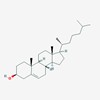
cholesterol
(3b)-cholest-5-en-3-ol
 
Notes:
the principal sterol of all higher animals, distributed in body tissues, especially the brain and spinal cord, and in animal fats and oils. Constit. either free or as esters, of fish liver oils, lard, dairy fats, egg yolk and bran About 20?25% of total daily cholesterol production occurs in the liver; other sites of high synthesis rates include the intestines, adrenal glands and reproductive organs. Synthesis within the body starts with one molecule of acetyl CoA and one molecule of acetoacetyl-CoA, which are dehydrated to form 3-hydroxy-3-methylglutaryl CoA (HMG-CoA). This molecule is then reduced to mevalonate by the enzyme HMG-CoA reductase. This step is an irreversible step in cholesterol synthesis and is the site of action for the statins (HMG-CoA Reductase Inhibitors).; Cholesterol is a lipidic, waxy steroid found in the cell membranes and transported in the blood plasma of all animals. It is an essential component of mammalian cell membranes where it is required to establish proper membrane permeability and fluidity. In addition, cholesterol is an important precursor molecule for the biosynthesis of bile acids, steroid hormones, and several fat soluble vitamins. Cholesterol is the principal sterol synthesized by animals, but small quantities are synthesized in other eukaryotes, such as plants and fungi. It is almost completely absent among prokaryotes, which include bacteria.; Cholesterol is a sterol (a combination steroid and alcohol) and a lipid found in the cell membranes of all body tissues, and transported in the blood plasma of all animals. The name originates from the Greek chole- (bile) and stereos (solid), and the chemical suffix -ol for an alcohol, as researchers first identified cholesterol (C27H45OH) in solid form in gallstones in 1784. Cholesterol is transported throughout the body via lipoprotein particles. The largest lipoproteins, which primarily transport fats from the intestinal mucosa to the liver, are called chylomicrons. They carry mostly triglyceride fats and cholesterol (that are from food and especially internal cholesterol secreted by the liver into the bile). In the liver, chylomicron particles give up triglycerides and some cholesterol, and are converted into low-density lipoprotein (LDL) particles, which carry triglycerides and cholesterol on to other body cells. In healthy individuals the LDL particles are large and relatively few in number. In contrast, large numbers of small LDL particles are strongly associated with promoting atheromatous disease within the arteries. (Lack of information on LDL particle number and size is one of the major problems of conventional lipid tests.). In conditions with elevated concentrations of oxidized LDL particles, especially small LDL particles, cholesterol promotes atheroma plaque deposits in the walls of arteries, a condition known as atherosclerosis, which is a major contributor to coronary heart disease and other forms of cardiovascular disease. (In contrast, HDL particles have been the only identified mechanism by which cholesterol can be removed from atheroma. Increased concentrations of large HDL particles, not total HDL particles, correlate with lower rates of atheroma progressions, even regression.). There is a world-wide trend to believe that lower total cholesterol levels tend to correlate with lower atherosclerosis event rates (though many studies refute this idea). Due to this reason, cholesterol has become a very large focus for scientific researchers trying to determine the proper amount of cholesterol needed in a healthy diet. However, the primary association of atherosclerosis with cholesterol has always been specifically with cholesterol transport patterns, not total cholesterol per se. For example, total cholesterol can be low, yet made up primarily of small LDL and small HDL particles and atheroma growth rates are high. In contrast, however, if LDL particle number is low (mostly large particles) and a large percentage of the HDL particles are large (HDL is actively reverse transporting cholesterol), then atheroma growth rates are usually low, even negative, for any given total cholesterol concentration. These effects are further complicated by the relative concentration of asymmetric dimethylarginin (ADMA) in the endothelium, since ADMA down-regulates production of nitric oxide, a relaxant of the endothelium. Thus, high levels of ADMA, associated with high oxidized levels of LDL pose a heightened risk factor for vascular disease. -- Wikipedia; Given the well-recognized role of cholesterol in cardiovascular disease, it is surprising that some studies have shown an inverse correlation between cholesterol levels and mortality in subjects over 50 years of age?an 11% increase overall and 14% increase in CVD mortality per 1 mg/dL per year drop in cholesterol levels. In the Framingham Heart Study, the researchers attributed this phenomenon to the fact that people with severe chronic diseases or cancer tend to have below-normal cholesterol levels. This explanation is not supported by the Vorarlberg Health Monitoring and Promotion Programme, in which men of all ages and women over 50 with very low cholesterol were increasingly likely to die of cancer, liver diseases, and mental diseases. This result indicates that the low cholesterol effect occurs even among younger respondents, contradicting the previous assessment among cohorts of older people that this is a proxy or marker for frailty occurring with age.; Mevalonate is then converted to 3-isopentenyl pyrophosphate in three reactions which require ATP. This molecule is decarboxylated to isopentenyl pyrophosphate, which is a key metabolite for various biological reactions. Three molecules of isopentenyl pyrophosphate condense to form farnesyl pyrophosphate through the action of geranyl transferase. Two molecules of farnesyl pyrophosphate then condense to form squalene by the action of squalene synthase in the endoplasmic reticulum. Oxidosqualene cyclase then cyclizes squalene to form lanosterol. Finally, lanosterol is then converted to cholesterol.; Within cells, cholesterol is the precursor molecule in several biochemical pathways. In the liver, cholesterol is converted to bile, which is then stored in the gallbladder. Bile contains bile salts, which solubilize fats in the digestive tract and aid in the intestinal absorption of fat molecules as well as the fat soluble vitamins, Vitamin A, Vitamin D, Vitamin E and Vitamin K. Cholesterol is an important precursor molecule for the synthesis of Vitamin D and the steroid hormones, including the adrenal gland hormones cortisol and aldosterone as well as the sex hormones progesterone, estrogens, and testosterone and their derivatives.
  • BOC Sciences
    • BOC Sciences
      Best of Chemicals Supplier
      Quality supplier of research chemicals and biochemicals including inhibitors, building blocks, GMP Products, impurities and metabolites, APIs for Veterinary, Natural Compounds, ADCs, Stem Cell Molecule and chiral compounds.
      BOC Sciences provides a wide range of services to support the pharmaceutical industry through all stages of drug discovery including Custom Synthesis of those chemicals that are not in stock, Isotope Labeling Service, Chiral Synthesis and Resolution, Bioconjugation, PEGylation services, analytical services.
      BOC Sciences is a brand of BOCSCI Inc. We leverage our wide spectrum of business in the fields of development, manufacturing, marketing, and distribution to help you make best-informed decisions tailored to your evolving needs for premium chemicals. Our complete suite of CRO services spans the entire molecule development pipeline including contract research for target identification, building blocks, compound synthesis, biochemical and cellular analysis, preclinical animal tests, and clinical studies.
      Email: Marketing
      US Email: Marketing
      Email: Sales
      US Email: Sales
      Voice: 1-631-485-4226
      Fax: 1-631-614-7828
      US Voice: 1-631-485-4226
      US Fax: 1-631-614-7828
      Europe44-203-286-1088
      Facebook
      Twitter
      Linkedin
      Blog
      Get the App!
      Product(s):
      57-88-5 Cholesterol >98%
      Cholesterol is the principal sterol of all higher animals required to build and maintain membranes.
       
       
  • Charkit Chemical
    • Charkit Chemical Corporation
      The Specialty Chemical Specialists
      Explore this website to discover the products and services that Charkit provides for your industry and please contact us directly to find out how we can be of service to you.
      about: Since 1982, Charkit has been committed to expanding the markets we serve as our roster of products and services continues to grow with us. Our substantial portfolio of personal care ingredients now include a wide array of luxury and exotic components to compliment the key products we have always offered. We have expanded our offerings to the nutraceutical, industrial, and resin markets with a growing roster of versatile and unique ingredients. We continue to lead the way in our traditional markets such as Metal and Water Treatment, Imaging, Flavor & Fragrance, Aroma and Food. Our Pharmaceutical offerings continue to expand, still anchored by the Boronic Derivatives that meet the demands of Suzuki coupling reactions. Please contact us to learn how we can help you reach your goals.
      Email: Sales
      Voice: 203-299-3220
      Fax: 203-299-1355
      Facebook
      Twitter
      Linkedin
      Latest News
      Events
      Blog
      Products List: View
      Product(s):
      CHOLESTEROL NF
       
  • ECSA Chemicals
    • ECSA Chemicals
      Human Chemistry
      ECSA Chemicals has been active since 1913 in the trading and international commerce of raw materials. With an organisation divided into industrial segments managed by specialists, it has become one of the largest distributors worldwide.
      ECSA Chemicals is the largest Swiss-owned company in terms of warehouses for the distribution of chemical products. We have been distributing chemical products for over 100 years and we have a special interest in protecting the environment and in the safety of our facilities and collaborators.
      Established in 1913 as a small grocery store, in its over 100 years of activity ECSA Chemicals has become one of the most important Swiss-owned distributors of chemical products. The company, which is active in international distribution and trading, is organised into industrial segments that are managed by teams of specialists and experts. They guarantee professional and customised consultancy and services. With our experience, we can rapidly and safely connect you with the best suppliers on the market, providing you with a complete search, consulting and assistance service. The focus of our approach and operations is you, our customers. We strive every day to find the best products that satisfy your needs as quickly as possible. Your satisfaction is our greatest success. WHY CHOOSE ECSA? EXPERIENCE We have been working for 100 years. QUALITY We have obtained many certifications (ISO, SQAS, GDP, Responsible Care, Bio-Inspecta, RSPO, etc.). We guarantee full compliance with the current laws and continuous training for our staff. SAFETY We constantly carry out risk analyses for each infrastructure, defining safety levels and implementing corrective measures promptly wherever they are needed. WIDESPREAD DISTRIBUTION We have warehouses in strategic locations to supply goods to Switzerland and to the rest of the world. STORAGE CAPACITY The 3 ECSA-owned warehouses guarantee considerable storage area and capacity in each warehouse, with full availability of products (base chemicals and speciality chemicals). SPEED Presence all over the country, staff dedicated to sourcing raw materials and considerable storage capacity guarantee that goods are rapidly obtained and supplied. CONSULTANCY Our specialists - in-depth knowledge of the market and products allows us to provide full consulting services, from the purchase to the supply of raw materials.
      Email: Info
      Email: Sales
      Email: Trading
      Email: Maintenance
      Email: Energy
      Voice: +41 91 695 88 00
      Fax: +41 91 695 88 01
      Linkedin
      Youtube
      RSS Feed
      ECSA Trade
      ECSA TRADE THE MOST UPDATED FINANCIAL PUBLICATION ON THE WORLD OF CHEMISTRY
      Products List: View
      Product(s):
      MP-015091 CHOLESTEROL
       
  • Glentham Life Sciences
  • Penta International
    • Penta International Corporation
      Chemistry innovation
      At Penta, our products and services help businesses do business better.
      For over 30 years, Penta Manufacturing Company has played a growing role in worldwide chemistry innovations and applications. As an industry leader, Penta continues to pioneer chemistry-based solutions for practically every area of commerce. Our products and expertise have helped fuel technical advances in dozens of commercial applications including flavoring, coloring, fragrances and chemical processes.
      US Email: Technical Services
      US Email: Sales
      US Voice: (973) 740-2300
      US Fax: (973) 740-1839
      Product(s):
      03-22700 CHOLESTEROL NF
       
Synonyms   Articles   Notes   Search
CAS Number: 57-88-5Picture of molecule3D/inchi
Other(deleted CASRN): 209124-38-9
ECHA EINECS - REACH Pre-Reg: 200-353-2
FDA UNII: 97C5T2UQ7J
Nikkaji Web: J2.804E
Beilstein Number: 1915888
MDL: MFCD00003646
XlogP3: 8.70 (est)
Molecular Weight: 386.66282000
Formula: C27 H46 O
BioActivity Summary: listing
NMR Predictor: Predict (works with chrome or firefox)
Category: cosmetic agents
 
US / EU / FDA / JECFA / FEMA / FLAVIS / Scholar / Patent Information:
Google Scholar: Search
Google Books: Search
Google Scholar: with word "volatile"Search
Google Scholar: with word "flavor"Search
Google Scholar: with word "odor"Search
Google Patents: Search
US Patents: Search
EU Patents: Search
Pubchem Patents: Search
PubMed: Search
NCBI: Search
Synonyms   Articles   Notes   Search   Top
Physical Properties:
Appearance: white to pale yellow crystals (est)
Assay: 95.00 to 100.00 % 
Food Chemicals Codex Listed: No
Melting Point: 148.00 to  149.00 °C. @ 760.00 mm Hg
Boiling Point: 360.00 °C. @ 760.00 mm Hg
Boiling Point: 480.00 to  481.00 °C. @ 760.00 mm Hg (est)
Flash Point: > 230.00 °F. TCC ( > 110.00 °C. )
logP (o/w): 9.619 (est)
Soluble in:
 water, 0.095 mg/L @ 30 °C (exp)
Synonyms   Articles   Notes   Search   Top
Organoleptic Properties:
Odor Strength: none
 
Odor Description:
at 100.00 %. 
bland
 
Odor and/or flavor descriptions from others (if found).
 
 
Synonyms   Articles   Notes   Search   Top
Cosmetic Information:
CosIng: cosmetic data
Cosmetic Uses: skin conditioning
skin conditioning - emollient
stabilising agents
surfactant - emulsifying
viscosity controlling agents
Synonyms   Articles   Notes   Search   Top
Suppliers:
Alfa Biotechnology
For experimental / research use only.
Cholesterol 98%
BOC Sciences
For experimental / research use only.
Cholesterol >98%
Odor: characteristic
Use: Cholesterol is the principal sterol of all higher animals required to build and maintain membranes.
Charkit Chemical
CHOLESTEROL NF
Croda
Cholesterol USP/NF
Odor: bland
Use: Excellent moisturiser with skin and hair conditioning benefits. Very effective in repairing skin barrier. Powerful W/O emulsifier and emulsion stabiliser.
ECSA Chemicals
CHOLESTEROL
ECSA TRADE THE MOST UPDATED FINANCIAL PUBLICATION ON THE WORLD OF CHEMISTRY
ExtraSynthese
For experimental / research use only.
Cholesterol (GC) ≥95%
Glentham Life Sciences
Cholesterol, non-animal origin
Glentham Life Sciences
Cholesterol, USP/NF grade, from lanolin
Glentham Life Sciences
Cholesterol
H. Erhard Wagner
Cholesterol HP
H. Erhard Wagner
Cholesterol Ph. Eur. 7.1 / NF 29
Odor: characteristic
Use: Cholesterol, an essential lipid, is a natural emulsifier, widely used in cosmetic and pharmaceutic formulations. The rawmaterial base is woolgrease.
H. Erhard Wagner
Cholesterol T (technical / feed)
Odor: characteristic
Use: Cholesterol for technical appliances and feed purpose. Content of Cholesterol: typically abt. 91% (not guaranteed).
Penta International
CHOLESTEROL NF
Sigma-Aldrich: Sigma
For experimental / research use only.
Cholesterol, Sigma Grade, ≥99%
Synonyms   Articles   Notes   Search   Top
Safety Information:
Preferred SDS: View
 
Hazards identification
 
Classification of the substance or mixture
GHS Classification in accordance with 29 CFR 1910 (OSHA HCS)
None found.
GHS Label elements, including precautionary statements
 
Pictogram
 
Hazard statement(s)
None found.
Precautionary statement(s)
None found.
Oral/Parenteral Toxicity:
Not determined
Dermal Toxicity:
Not determined
Inhalation Toxicity:
Not determined
Synonyms   Articles   Notes   Search   Top
Safety in Use Information:
Category: cosmetic agents
Recommendation for cholesterol usage levels up to:
 not for fragrance use.
 
Recommendation for cholesterol flavor usage levels up to:
 not for flavor use.
Synonyms   Articles   Notes   Search   Top
Safety References:
EPI System: View
ClinicalTrials.gov: search
Daily Med: search
Chemical Carcinogenesis Research Information System: Search
AIDS Citations: Search
Cancer Citations: Search
Toxicology Citations: Search
EPA GENetic TOXicology: Search
EPA Substance Registry Services (TSCA): 57-88-5
EPA ACToR: Toxicology Data
EPA Substance Registry Services (SRS): Registry
Laboratory Chemical Safety Summary : 5997
National Institute of Allergy and Infectious Diseases: Data
WGK Germany: 1
 (3S,8S,9S,10R,13R,14S,17R)-10,13-dimethyl-17-[(2R)-6-methylheptan-2-yl]-2,3,4,7,8,9,11,12,14,15,16,17-dodecahydro-1H-cyclopenta[a]phenanthren-3-ol
Chemidplus: 0000057885
RTECS: FZ8400000 for cas# 57-88-5
Synonyms   Articles   Notes   Search   Top
References:
 (3S,8S,9S,10R,13R,14S,17R)-10,13-dimethyl-17-[(2R)-6-methylheptan-2-yl]-2,3,4,7,8,9,11,12,14,15,16,17-dodecahydro-1H-cyclopenta[a]phenanthren-3-ol
NIST Chemistry WebBook: Search Inchi
Canada Domestic Sub. List: 57-88-5
Pubchem (cid): 5997
Pubchem (sid): 134971197
Synonyms   Articles   Notes   Search   Top
Other Information:
(IUPAC): Atomic Weights of the Elements 2011 (pdf)
Videos: The Periodic Table of Videos
tgsc: Atomic Weights use for this web site
(IUPAC): Periodic Table of the Elements
CHEBI: View
CHEMBL: View
Golm Metabolome Database: Search
KEGG (GenomeNet): C00187
HMDB (The Human Metabolome Database): HMDB00067
FooDB: FDB013269
YMDB (Yeast Metabolome Database): YMDB00313
Export Tariff Code: 2906.13.5000
VCF-Online: VCF Volatile Compounds in Food
ChemSpider: View
Wikipedia: View
Formulations/Preparations:
technical, usp, scw (standard for clinical work)
Synonyms   Articles   Notes   Search   Top
Potential Blenders and core components note
 
None Found
 
Synonyms   Articles   Notes   Search   Top
Potential Uses:
 emollients 
 emulsifying agents 
Synonyms   Articles   Notes   Search   Top
Occurrence (nature, food, other): note
 apple custard apple plant
Search Trop  Picture
 apricot seed
Search Trop  Picture
 avocado plant
Search Trop  Picture
 banana fruit
Search Trop  Picture
 bean fava bean oil
Search Trop  Picture
 cacao oil
Search Trop  Picture
 cardamom seed
Search Trop  Picture
 carrot leaf
Search Trop  Picture
 coffee bean
Search Trop  Picture
 corn root
Search Trop  Picture
 corn seed
Search Trop  Picture
 corn shoot
Search Trop  Picture
 date palm
Search Trop  Picture
 date palm fruit
Search Trop  Picture
 date palm pollen
Search Trop  Picture
 elder black elder flower
Search Trop  Picture
 elder black elder plant
Search Trop  Picture
 fenugreek seed
Search Trop  Picture
 fenugreek tissue culture
Search Trop  Picture
 flax seed
Search Trop  Picture
 garlic bulb
Search Trop  Picture
 grape fruit
Search Trop  Picture
 hordeum vulgare l.cv mammut
Search Trop  Picture
 mandarin pericarp
Search Trop  Picture
 mandarin root
Search Trop  Picture
 marango seed
Search Trop  Picture
 melon bitter melon fruit
Search Trop  Picture
 mustard white mustard seed
Search Trop  Picture
 oat leaf
Search Trop  Picture
 oat seed
Search Trop  Picture
 onion bulb
Search Trop  Picture
 onion seed
Search Trop  Picture
 orange fruit
Search Trop  Picture
 papaya seed oil
Search Trop  Picture
 pea seed
Search Trop  Picture
 peanut plant
Search Trop  Picture
 pomegranate seed
Search Trop  Picture
 potato plant
Search Trop  Picture
 roselle seed
Search Trop  Picture
 rosemary shoot
Search Trop  Picture
 sage fruit oil
Search Trop  Picture
 sesame seed oil
Search Trop  Picture
 soursop plant
Search Trop  Picture
 soybean seed
Search Trop  Picture
 spinach leaf
Search Trop  Picture
 sunflower seed
Search Trop  Picture
 turmeric rhizome
Search Trop  Picture
 walnut english walnut nut
Search Trop  Picture
Synonyms   Articles   Notes   Search   Top
Synonyms:
 cholest-5-en-3-beta-ol
(3b)-cholest-5-en-3-ol
 cholest-5-en-3b-ol
5-cholesten-3b-ol
 cholesterin
 cholesterine
 cholesterinum
(-)-cholesterol
 cholesteryl alcohol
(1S,2R,5S,10S,11S,14R,15R)-2,15-dimethyl-14-[(2R)-6-methylheptan-2-yl]tetracyclo[8.7.0.02,7.011,15]heptadec-7-en-5-ol
(3S,8S,9S,10R,13R,14S,17R)-10,13-dimethyl-17-((R)-6-methylheptan-2-yl)-2,3,4,7,8,9,10,11,12,13,14,15,16,17-tetradecahydro-1H-cyclopenta[a]phenanthren-3-ol
(3S,8S,9S,10R,13R,14S,17R)-10,13-dimethyl-17-[(2R)-6-methyl-2-heptanyl]-2,3,4,7,8,9,10,11,12,13,14,15,16,17-tetradecahydro-1H-cyclopenta[a]phenanthren-3-ol
(3S,8S,9S,10R,13R,14S,17R)-10,13-dimethyl-17-[(2R)-6-methylheptan-2-yl]-2,3,4,7,8,9,11,12,14,15,16,17-dodecahydro-1H-cyclopenta[a]phenanthren-3-ol
14-((1R)-1,5-dimethylhexyl)(1S,5S,10S,11S,2R,14R,15R)-2,15-dimethyltetracyclo[ 8.7.0.0<2,7>.0<11,15>]heptadec-7-en-5-ol
14-((1R)-1,5-dimethylhexyl)(1S,5S,10S,11S,2R,14R,15R)-2,15-dimethyltetracyclo[8.7.0.0<2,7>.0<11,15>]heptadec-7-en-5-ol
(3S,8S,9S,10R,13R,14S,17R)-17-[(1R)-1,5-dimethylhexyl]-10,13-dimethyl-2,3,4,7,8,9,11,12,14,15,16,17-dodecahydro-1H-cyclopenta[a]phenanthren-3-ol
3b-hydroxy-5-cholestene
 provitamin D
 synthechol
Synonyms   Articles   Notes   Search   Top
Please share your Comments.
Email Address:


Top of Page Home
Copyright © 1980-2021 Perflavory ™ Disclaimer Privacy Policy