|
Category: cosmetic agents
US / EU / FDA / JECFA / FEMA / FLAVIS / Scholar / Patent Information:
Physical Properties:
| Appearance: | white to pale yellow crystalline powder (est) |
| Assay: | 95.00 to 100.00 %
|
| Food Chemicals Codex Listed: | No |
| Melting Point: | 75.50 °C. @ 760.00 mm Hg
|
| Boiling Point: | 267.00 °C. @ 760.00 mm Hg
|
| Vapor Pressure: | 0.001660 mmHg @ 25.00 °C. (est) |
| Flash Point: | 290.00 °F. TCC ( 143.10 °C. ) (est)
|
| logP (o/w): | 2.020 |
| Soluble in: |
| | water, 556 mg/L @ 20 °C (exp) | | | water, 7965 mg/L @ 25 °C (est) |
Organoleptic Properties:
| |
| Odor and/or flavor descriptions from others (if found). |
| |
| |
Cosmetic Information:
Suppliers:
Safety Information:
| Preferred SDS: View |
| |
| Hazards identification |
| |
| Classification of the substance or mixture |
| GHS Classification in accordance with 29 CFR 1910 (OSHA HCS) |
| None found. |
| GHS Label elements, including precautionary statements |
| |
| Pictogram | |
| |
| Hazard statement(s) |
| None found. |
| Precautionary statement(s) |
| None found. |
| Oral/Parenteral Toxicity: |
oral-guinea pig LD20 1205 mg/kg
Teratology, The International Journal of Abnormal Development. Vol. 20, Pg. 413, 1979.
unreported-mammal (species unspecified) LD50 1000 mg/kg
"Chemistry of Pesticides," Melnikov, N.N., New York, Springer-Verlag New York, Inc., 1971Vol. -, Pg. 410, 1971.
intraperitoneal-mouse LD50 43 mg/kg
Farmakologiya i Toksikologiya Vol. 42, Pg. 396, 1979.
oral-mouse LD50 20000 mg/kg
Drugs in Japan Vol. 6, Pg. 271, 1982.
oral-rat LD50 1200 mg/kg
Pesticide Chemicals Official Compendium, Association of the American Pesticide Control Officials, Inc., 1966. Vol. -, Pg. 602, 1966.
|
| Dermal Toxicity: |
subcutaneous-mouse LD50 83600 ug/kg
Pharmazie. Vol. 1, Pg. 150, 1946.
|
| Inhalation Toxicity: |
inhalation-rat LC50 > 1210 mg/m3/6H
Journal of the American College of Toxicology. Vol. 11, Pg. 497, 1992.
|
Safety in Use Information:
| Category: | cosmetic agents |
| Recommendation for oxyquinoline usage levels up to: | | | not for fragrance use.
|
| |
| Recommendation for oxyquinoline flavor usage levels up to: |
| | not for flavor use.
|
Safety References:
References:
Other Information:
Potential Blenders and core components notePotential Uses:
Occurrence (nature, food, other): noteSynonyms:
| oxy | benzopyridine | | | bioquin | | oxy | chinolin | | 8- | chinolinol | | | fennosan | | 8- | hydroxy quinoline | | 8- | hydroxy-chinolin | | (8- | hydroxy)quinoline | | 8- | hydroxychinolin | | 8- | hydroxylquinoline | | 8- | hydroxyquinolin-n-oxide | | 8- | hydroxyquinoline | | 1-aza | naphthalene-8-ol | | aza | naphthalene-8-ol | | | oxine | | | quino phenol | | 8- | quinol | | | quinolin-8-ol | | 8-oxy | quinoline | | | quinoline, 8-hydroxy- | | | quinolinol | | 8- | quinolinol | | | quinophenol | | | tumex |
Articles:
|



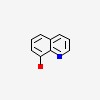 3D/inchi