Articles:
pent-4-yn-1-oic acid
Notes:
None found

-
BOC Sciences Best of Chemicals Supplier Quality supplier of research chemicals and biochemicals including inhibitors, building blocks, GMP Products, impurities and metabolites, APIs for Veterinary, Natural Compounds, ADCs, Stem Cell Molecule and chiral compounds. BOC Sciences provides a wide range of services to support the pharmaceutical industry through all stages of drug discovery including Custom Synthesis of those chemicals that are not in stock, Isotope Labeling Service, Chiral Synthesis and Resolution, Bioconjugation, PEGylation services, analytical services. BOC Sciences is a brand of BOCSCI Inc. We leverage our wide spectrum of business in the fields of development, manufacturing, marketing, and distribution to help you make best-informed decisions tailored to your evolving needs for premium chemicals. Our complete suite of CRO services spans the entire molecule development pipeline including contract research for target identification, building blocks, compound synthesis, biochemical and cellular analysis, preclinical animal tests, and clinical studies. Email: Marketing US Email: Marketing Email: Sales US Email: Sales Voice: 1-631-485-4226 Fax: 1-631-614-7828 US Voice: 1-631-485-4226 US Fax: 1-631-614-7828 Europe 44-203-286-1088 Facebook Twitter Linkedin Blog Get the App! Product(s): 6089-09-4 4-Pentynoic acid 95%
-

-
Endeavour Specialty Chemicals Ltd Expertise in high impact aroma chemicals Endeavour Speciality Chemicals offers high-impact aroma chemicals, at small to medium scale. Speciality Chemical has more than 25 years experience of manufacturing high-impact aroma chemicals. With our core expertise in sulfur and heterocyclic chemistries, Endeavours products have applications in a range of industry sectors including flavours and fragrances, pharmaceutical research and material sciences. Endeavour also offer custom synthesis and contract manufacturing services at their UK manufacturing site. Email: Info Email: Sales Voice: +44 (0)1327 310 079 Fax: +44 (0)1327 310 701 Twitter Linkedin News Speciality Chemical Product Groups Product(s): ZCA0080 4-Pentynoic acid
-

-
Robinson Brothers Limited Providing Excellence in Chemistry Award-winning UK chemical manufacturer of chemical intermediates and high-impact aroma chemicals. Based in the UK, Robinson Brothers is an award-winning chemical manufacturer of chemical intermediates and high-impact aroma chemicals. Robinson Brothers serve many industry sectors across the globe, include: flavour/fragrance, pharmaceutical, agrochemical and material sciences. Our team of Chemists are experts in custom synthesis, contract manufacture and process optimisation. Email: Info Email: Sales Voice: +44 (0)121 553 2451 Fax: +44 (0)121 500 5183 Twitter Linkedin News And Exhibitions Custom Synthesis Industries And Applications https://www.robinsonbrothers.uk/chemistry-competences Products List: View Product(s): ZCA0080 4-Pentynoic acid
-

-
TCI AMERICA Moving Your Chemistry Forward We continuously strive to advance our technology. With East & West Coast distribution centers, count on TCI to deliver products quickly and reliably. Over 30,000 Reagents available today in benchtop to bulk quantities. We also offer custom synthesis solutions. Sign up for a TCI account today for fast and free shipping! Tokyo Chemical Industry Co., Ltd. (TCI) is a leading worldwide manufacturer of specialty organic chemicals founded in 1946. TCI provides organic laboratory chemicals as well as pharmaceutical, cosmetic and functional materials. More than 70 years of synthesis experience and multi-purpose plants enable TCI to offer more than 30,000 products as well as custom synthesis. US Email: Sales Email: Technical Support Voice: 1-800-423-8616 Fax: 1- 888-520-1075 Facebook Twitter Instagram Linkedin Product(s): P2341 4-Pentynoic Acid >98.0%(GC)(T)
-
| CAS Number: | 6089-09-4 | 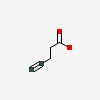 3D/inchi 3D/inchi
|
| ECHA EINECS - REACH Pre-Reg: | 228-028-0 | |
| Nikkaji Web: | J69.139I | |
| Beilstein Number: | 1742047 | |
| MDL: | MFCD00004407 | |
| XlogP3-AA: | 0.30 (est) | |
| Molecular Weight: | 98.10122000 | |
| Formula: | C5 H6 O2 | |
| NMR Predictor: | Predict (works with chrome or firefox) | |
Category: information only not used for fragrances or flavors
US / EU / FDA / JECFA / FEMA / FLAVIS / Scholar / Patent Information:
| Google Scholar: | Search |
| Google Books: | Search |
| Google Scholar: with word "volatile" | Search |
| Google Scholar: with word "flavor" | Search |
| Google Scholar: with word "odor" | Search |
| Google Patents: | Search |
| US Patents: | Search |
| EU Patents: | Search |
| Pubchem Patents: | Search |
| PubMed: | Search |
| NCBI: | Search |
Physical Properties:
| Assay: | 95.00 to 100.00 % |
| Food Chemicals Codex Listed: | No |
| Melting Point: | 57.70 °C. @ 760.00 mm Hg |
| Boiling Point: | 199.20 °C. @ 760.00 mm Hg (est) |
| Vapor Pressure: | 0.146000 mmHg @ 25.00 °C. (est) |
| Flash Point: | 195.00 °F. TCC ( 90.80 °C. ) (est) |
| logP (o/w): | 0.402 (est) |
| Soluble in: | |
| water, 6.239e+004 mg/L @ 25 °C (est) | |
Organoleptic Properties:
| Odor and/or flavor descriptions from others (if found). | |
Cosmetic Information:
| None found |
Suppliers:
| BOC Sciences |
| For experimental / research use only. |
| 4-Pentynoic acid 95% |
| Endeavour Specialty Chemicals |
| 4-Pentynoic acid |
| Speciality Chemical Product Groups |
| Matrix Scientific |
| For experimental / research use only. |
| 4-Pentynoic acid, 95% |
| Robinson Brothers |
| 4-Pentynoic acid |
| https://www.robinsonbrothers.uk/chemistry-competences |
| Santa Cruz Biotechnology |
| For experimental / research use only. |
| 4-Pentynoic Acid 98% |
| Sigma-Aldrich: Aldrich |
| For experimental / research use only. |
| 4-Pentynoic acid 95% |
| TCI AMERICA |
| For experimental / research use only. |
| 4-Pentynoic Acid >98.0%(GC)(T) |
Safety Information:
| Preferred SDS: View | |
| Hazards identification | |
| Classification of the substance or mixture | |
| GHS Classification in accordance with 29 CFR 1910 (OSHA HCS) | |
| None found. | |
| GHS Label elements, including precautionary statements | |
| Pictogram | |
| Hazard statement(s) | |
| None found. | |
| Precautionary statement(s) | |
| None found. | |
| Oral/Parenteral Toxicity: | |
|
intravenous-mouse LD50 28 mg/kg U.S. Army Armament Research & Development Command, Chemical Systems Laboratory, NIOSH Exchange Chemicals. Vol. NX#12263 | |
| Dermal Toxicity: | |
| Not determined | |
| Inhalation Toxicity: | |
| Not determined | |
Safety in Use Information:
| Category: | information only not used for fragrances or flavors | ||
| Recommendation for 4-pentynoic acid usage levels up to: | |||
| not for fragrance use. | |||
| Recommendation for 4-pentynoic acid flavor usage levels up to: | |||
| not for flavor use. | |||
Safety References:
| EPI System: | View |
| AIDS Citations: | Search |
| Cancer Citations: | Search |
| Toxicology Citations: | Search |
| EPA ACToR: | Toxicology Data |
| EPA Substance Registry Services (SRS): | Registry |
| Laboratory Chemical Safety Summary : | 22464 |
| National Institute of Allergy and Infectious Diseases: | Data |
| WGK Germany: | 3 |
| pent-4-ynoic acid | |
| Chemidplus: | 0006089094 |
| RTECS: | SC4751000 for cas# 6089-09-4 |
References:
| pent-4-ynoic acid | |
| NIST Chemistry WebBook: | Search Inchi |
| Pubchem (cid): | 22464 |
| Pubchem (sid): | 134988743 |
Other Information:
| (IUPAC): | Atomic Weights of the Elements 2011 (pdf) |
| Videos: | The Periodic Table of Videos |
| tgsc: | Atomic Weights use for this web site |
| (IUPAC): | Periodic Table of the Elements |
| HMDB (The Human Metabolome Database): | Search |
| Export Tariff Code: | 2916.19.3000 |
| ChemSpider: | View |
Potential Blenders and core components note
| None Found | ||
Potential Uses:
| None Found |
Occurrence (nature, food, other): note
| not found in nature |
Synonyms:
| pent-4-yn-1-oic acid | |
| pent-4-ynoic acid | |
| propargylacetic acid |