|
Category: pharmaceuticals / chemical synthisis
US / EU / FDA / JECFA / FEMA / FLAVIS / Scholar / Patent Information:
Physical Properties:
| Assay: | 95.00 to 100.00 %
|
| Food Chemicals Codex Listed: | No |
| Specific Gravity: | 1.03400 @ 25.00 °C.
|
| Melting Point: | 11.80 °C. @ 760.00 mm Hg
|
| Boiling Point: | 101.50 °C. @ 760.00 mm Hg
|
| Vapor Pressure: | 38.233002 mmHg @ 25.00 °C. (est) |
| Flash Point: | 54.00 °F. TCC ( 12.22 °C. )
|
| logP (o/w): | -0.270 |
| Soluble in: |
| | water, 2.139e+005 mg/L @ 25 °C (est) | | | water, 1.00E+06 mg/L @ 20 °C (exp) |
Organoleptic Properties:
| |
| Odor and/or flavor descriptions from others (if found). |
| |
| |
Cosmetic Information:
Suppliers:
| BASF |
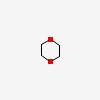
| 1,4-Dioxane
|
| Charkit Chemical |
| DIOXANE, 1,4- (0.003% WATER)
|
| ECSA Chemicals |
| 1,4-DIOXANE RE-PURE, ML 2500
|
| ECSA TRADE THE MOST UPDATED FINANCIAL PUBLICATION ON THE WORLD OF CHEMISTRY |
| ECSA Chemicals |
| 1,4-DIOXANE RPE-ACS-FOR ANALYSIS-REAG. PH.EU
|
| EMD Millipore |
| For experimental / research use only. |
| 1,4-Dioxane
|
| Glentham Life Sciences |
| 1,4-Dioxane
|
| Santa Cruz Biotechnology |
| For experimental / research use only. |
| 1,4-Dioxane ≥99%
|
| Sigma-Aldrich |
| For experimental / research use only. |
| 1,4-Dioxane anhydrous, 99.8%
|
| TCI AMERICA |
| For experimental / research use only. |
| 1,4-Dioxane >99.0%(GC)
|
Safety Information:
| Preferred SDS: View |
| |
| Hazards identification |
| |
| Classification of the substance or mixture |
| GHS Classification in accordance with 29 CFR 1910 (OSHA HCS) |
| None found. |
| GHS Label elements, including precautionary statements |
| |
| Pictogram | |
| |
| Hazard statement(s) |
| None found. |
| Precautionary statement(s) |
| None found. |
| Oral/Parenteral Toxicity: |
oral-cat LD50 2000 mg/kg
Journal of Industrial Hygiene and Toxicology. Vol. 21, Pg. 173, 1939.
intravenous-cat LDLo 1500 mg/kg
BEHAVIORAL: ALTERED SLEEP TIME (INCLUDING CHANGE IN RIGHTING REFLEX)
BEHAVIORAL: IRRITABILITY
Journal of Hygiene. Vol. 35, Pg. 540, 1935.
oral-guinea pig LD50 3150 mg/kg
KIDNEY, URETER, AND BLADDER: OTHER CHANGES
BEHAVIORAL: GENERAL ANESTHETIC
GASTROINTESTINAL: OTHER CHANGES
Journal of Industrial Hygiene and Toxicology. Vol. 23, Pg. 259, 1941.
intraperitoneal-mouse LD50 790 mg/kg
LUNGS, THORAX, OR RESPIRATION: OTHER CHANGES
KIDNEY, URETER, AND BLADDER: "CHANGES IN TUBULES (INCLUDING ACUTE RENAL FAILURE, ACUTE TUBULAR NECROSIS)"
Federation Proceedings, Federation of American Societies for Experimental Biology. Vol. 6, Pg. 342, 1947.
oral-mouse LD50 5300 mg/kg
Indian Journal of Experimental Biology. Vol. 16, Pg. 54, 1978.
oral-rabbit LD50 2000 mg/kg
Journal of Industrial Hygiene and Toxicology. Vol. 21, Pg. 173, 1939.
intravenous-rabbit LDLo 1500 mg/kg
KIDNEY, URETER, AND BLADDER: URINE VOLUME INCREASED
KIDNEY, URETER, AND BLADDER: URINE VOLUME DECREASED
Journal of Hygiene. Vol. 35, Pg. 540, 1935.
intraperitoneal-rat LD50 799 mg/kg
Environmental Research. Vol. 40, Pg. 411, 1986.
oral-rat LD50 4200 mg/kg
Industrial Health. Vol. 32, Pg. 145, 1994.
|
| Dermal Toxicity: |
skin-rabbit LD50 7600 uL/kg
Union Carbide Data Sheet. Vol. 12/17/1971
|
| Inhalation Toxicity: |
inhalation-cat LCLo 44000 mg/m3/7H
BEHAVIORAL: EXCITEMENT
LUNGS, THORAX, OR RESPIRATION: DYSPNEA
"Beitrag zur Toxikologischen Wirkung Technischer Losungsmittel, Dissertation," Klimmer, O., Pharmakologischen Institut der Universitat Wurzburg, Fed. Rep. Ger., 1937Vol. -, Pg. -, 1937.
inhalation-human LCLo 470 ppm/3D
LUNGS, THORAX, OR RESPIRATION: OTHER CHANGES
BRAIN AND COVERINGS: OTHER DEGENERATIVE CHANGES
LIVER: OTHER CHANGES
Pollution Engineering. Vol. 7(9), Pg. 22, 1975.
inhalation-human TCLo 470 ppm
GASTROINTESTINAL: OTHER CHANGES
VASCULAR: BP ELEVATION NOT CHARACTERIZED IN AUTONOMIC SECTION
BEHAVIORAL: CONVULSIONS OR EFFECT ON SEIZURE THRESHOLD
AMA Archives of Industrial Health. Vol. 20, Pg. 445, 1959.
inhalation-human TCLo 5500 ppm/1M
SENSE ORGANS AND SPECIAL SENSES: CONJUNCTIVE IRRITATION: EYE
SENSE ORGANS AND SPECIAL SENSES: LACRIMATION: EYE
LUNGS, THORAX, OR RESPIRATION: OTHER CHANGES
Public Health Reports. Vol. 45, Pg. 2023, 1930.
inhalation-mammal (species unspecified) LC50 20500 mg/m3
Gigiena i Sanitariya. For English translation, see HYSAAV. Vol. 51(5), Pg. 61, 1986.
inhalation-mouse LC50 37000 mg/m3/2H
"Toxicometric Parameters of Industrial Toxic Chemicals Under Single Exposure," Izmerov, N.F., et al., Moscow, Centre of International Projects, GKNT, 1982Vol. -, Pg. 63, 1982.
inhalation-rat LC50 46000 mg/m3/2H
SENSE ORGANS AND SPECIAL SENSES: OTHER: EYE
Kosmicheskaya Biologiya I Aviakosmicheskaya Meditsina. Space Biology and Aerospace Medicine. Vol. 11(6), Pg. 53, 1977.
|
Safety in Use Information:
| Category: | pharmaceuticals / chemical synthisis |
| Recommendation for 1,4-dioxane usage levels up to: | | | not for fragrance use.
|
| |
| Recommendation for 1,4-dioxane flavor usage levels up to: |
| | not for flavor use.
|
Safety References:
References:
Other Information:
Potential Blenders and core components notePotential Uses:
Occurrence (nature, food, other): noteSynonyms:
| | di (ethylene oxide) | | | di(ethylene oxide) | | | diethylene dioxide | | 1,4- | diethylene dioxide | | | diethylene ether | | | diethylene oxide | | 1,4- | diethylenedioxide | | 1,4- | diethyleneoxide | | | diokan | | | dioksan | | 1,4- | dioxacyclohexane | | p- | dioxane | | | dioxane, 1,4- | | | dioxanne | | | ethylene glycol ethylene ether | | | glycol ethylene ether | | | glycolethylenether |
Articles:
|




 3D/inchi