|
Category: cosmetic ingredient for skin conditioning
US / EU / FDA / JECFA / FEMA / FLAVIS / Scholar / Patent Information:
Physical Properties:
| Assay: | 95.00 to 100.00 %
|
| Food Chemicals Codex Listed: | No |
| Melting Point: | 218.00 °C. @ 760.00 mm Hg
|
| Boiling Point: | 732.82 °C. @ 760.00 mm Hg (est)
|
| Flash Point: | 747.00 °F. TCC ( 397.00 °C. ) (est)
|
| logP (o/w): | -1.970 (est) |
| Soluble in: |
| | water, 1.58E+04 mg/L @ 20 °C (exp) | | | water, 5.691e+004 mg/L @ 25 °C (est) |
Organoleptic Properties:
| |
| Odor and/or flavor descriptions from others (if found). |
| |
| |
Cosmetic Information:
Suppliers:
Safety Information:
| Preferred SDS: View |
| |
| Hazards identification |
| |
| Classification of the substance or mixture |
| GHS Classification in accordance with 29 CFR 1910 (OSHA HCS) |
| None found. |
| GHS Label elements, including precautionary statements |
| |
| Pictogram | |
| |
| Hazard statement(s) |
| None found. |
| Precautionary statement(s) |
| None found. |
| Oral/Parenteral Toxicity: |
intraperitoneal-mouse LD50 3175 mg/kg
Pharmaceutical Chemistry Journal Vol. 20, Pg. 160, 1986.
intravenous-mouse LD50 > 2800 mg/kg
Drugs in Japan Vol. -, Pg. 156, 1995.
oral-mouse LD50 > 20000 mg/kg
Drugs in Japan Vol. 6, Pg. 77, 1982.
intraperitoneal-rat LD50 2900 mg/kg
Drugs in Japan Vol. 6, Pg. 77, 1982.
intravenous-rat LD50 > 2000 mg/kg
Drugs in Japan Vol. 6, Pg. 77, 1982.
oral-rat LD50 > 10000 mg/kg
Drugs in Japan Vol. -, Pg. 156, 1995.
|
| Dermal Toxicity: |
subcutaneous-mouse LD50 5000 mg/kg
Drugs in Japan Vol. 6, Pg. 77, 1982.
|
| Inhalation Toxicity: |
|
Not determined
|
Safety in Use Information:
| Category: | cosmetic ingredient for skin conditioning |
| Recommendation for inosine usage levels up to: | | | not for fragrance use.
|
| |
| Recommendation for inosine flavor usage levels up to: |
| | not for flavor use.
|
Safety References:
| European Food Safety Authority (EFSA) reference(s): |
Scientific Report of EFSA on the risk assessment of salts of authorised acids, phenols or alcohols for use in food contact materials [1]
View page or View pdf |
| EPI System: | View |
| ClinicalTrials.gov: | search |
| AIDS Citations: | Search |
| Cancer Citations: | Search |
| Toxicology Citations: | Search |
| EPA Substance Registry Services (TSCA): | 58-63-9 |
| EPA ACToR: | Toxicology Data |
| EPA Substance Registry Services (SRS): | Registry |
| Laboratory Chemical Safety Summary : | 6021 |
| National Institute of Allergy and Infectious Diseases: | Data |
| WGK Germany: | 2 |
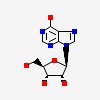
| | 9-[(2R,3R,4S,5R)-3,4-dihydroxy-5-(hydroxymethyl)oxolan-2-yl]-3H-purin-6-one |
| Chemidplus: | 0000058639 |
| RTECS: | NM7460000 for cas# 58-63-9 |
References:
| | 9-[(2R,3R,4S,5R)-3,4-dihydroxy-5-(hydroxymethyl)oxolan-2-yl]-3H-purin-6-one |
| NIST Chemistry WebBook: | Search Inchi |
| Canada Domestic Sub. List: | 58-63-9 |
| Pubchem (cid): | 6021 |
| Pubchem (sid): | 134971803 |
Other Information:
Potential Blenders and core components notePotential Uses:
Occurrence (nature, food, other): noteSynonyms:
| | atorel | | 1,9- | dihydro-9-b-D-ribofuranosyl-6H-purin-6-one | | 9-[(2R,3R,4S,5R)-3,4- | dihydroxy-5-(hydroxymethyl)oxolan-2-yl]-3H-purin-6-one | | 9-[(2R,3R,4S,5R)-3,4- | dihydroxy-5-(hydroxymethyl)tetrahydro-2-furanyl]-1,9-dihydro-6h-purin-6-one | | 9-((2R,3R,4S,5R)-3,4- | dihydroxy-5-(hydroxymethyl)tetrahydrofuran-2-yl)-1H-purin-6(9H)-one | | 9-((2R,3R,4S,5R)-3,4- | dihydroxy-5-hydroxymethyl-tetrahydro-furan-2-yl)-1,9-dihydro-purin-6-one | | | hypoxanthine D-riboside | | | hypoxanthine-9-D-ribofuranoside | | | inosie | | | inosin | | | inosina | | (-)- | inosine | | | inosinum | | | inotin | | | oxiamin | | iso- | prinosine | | 9-b-D- | ribofuranosyl-hypoxanthine | | 9-b-D- | ribofuranosylhypoxanthine | | | ribonosine | | | selfer | | | trophicardyl |
Articles:
|




 3D/inchi