|
Category: flavoring agents and adjuvants, curing and pickling agents, flavor enhancers
US / EU / FDA / JECFA / FEMA / FLAVIS / Scholar / Patent Information:
Physical Properties:
| Appearance: | white powder crystals (est) |
| Assay: | 99.00 to 100.00 %
|
| Food Chemicals Codex Listed: | Yes |
| Melting Point: | 152.00 to 154.00 °C. @ 760.00 mm Hg
|
| Boiling Point: | 265.00 °C. @ 100.00 mm Hg
|
| Boiling Point: | 216.00 °C. @ 15.00 mm Hg
|
| Vapor Pressure: | 1.000000 mmHg @ 159.00 °C. |
| Vapor Density: | 5.0 ( Air = 1 ) |
| Flash Point: | 385.00 °F. TCC ( 196.11 °C. )
|
| logP (o/w): | 0.080 |
| Soluble in: |
| | alcohol | | | water, hot water | | | water, slightly soluble in cold water | | | water, 30800 mg/L @ 34C (exp) |
| Insoluble in: |
| | paraffin oil |
| Similar Items: note |
| butane dicarboxylic anhydride |
Organoleptic Properties:
| Odor Strength: | none |
| |
Odor Description:
at 100.00 %. | odorless |
| |
| Odor and/or flavor descriptions from others (if found). |
| |
| |
Cosmetic Information:
Suppliers:
Safety Information:
| Preferred SDS: View |
| European information : |
| Most important hazard(s): | | Xi - Irritant |
R 36 - Irritating to eyes.
S 02 - Keep out of the reach of children.
S 26 - In case of contact with eyes, rinse immediately with plenty of water and seek medical advice.
S 36 - Wear suitable protective clothing.
|
| |
| Hazards identification |
| |
| Classification of the substance or mixture |
| GHS Classification in accordance with 29 CFR 1910 (OSHA HCS) |
Serious eye damage (Category 1), H318
Acute aquatic toxicity (Category 3), H402
|
| GHS Label elements, including precautionary statements |
| |
| Pictogram |  |
| |
| Signal word | Danger |
| Hazard statement(s) |
H318 - Causes serious eye damage
H402 - Harmful to aquatic life
|
| Precautionary statement(s) |
P273 - Avoid release to the environment.
P280 - Wear protective gloves/protective clothing/eye protection/face protection.
P305 + P351 + P338 - IF IN EYES: Rinse cautiously with water for several minutes. Remove contact lenses, if present and easy to do. Continue rinsing.
P310 - Immediately call a POISON CENTER or doctor/physician.
P501 - Dispose of contents/ container to an approved waste disposal plant.
|
| Oral/Parenteral Toxicity: |
oral-rat LD50 > 11000 mg/kg
Gigiena i Sanitariya. For English translation, see HYSAAV. Vol. 48(9), Pg. 72, 1983.
oral-mouse LD50 [sex: M] 1900 mg/kg
Dosed as a 6% suspension in 0.5% methyl cellulose.
(Horn et al., 1957)
intraperitoneal-rat LD50 275 mg/kg
GASTROINTESTINAL: OTHER CHANGES
BEHAVIORAL: SOMNOLENCE (GENERAL DEPRESSED ACTIVITY)
BLOOD: HEMORRHAGE
Journal of Agricultural and Food Chemistry. Vol. 5, Pg. 759, 1957.
oral-rabbit LD50 > 11000 mg/kg
Gigiena i Sanitariya. For English translation, see HYSAAV. Vol. 48(9), Pg. 72, 1983.
intravenous-mouse LD50 680 mg/kg
BEHAVIORAL: CONVULSIONS OR EFFECT ON SEIZURE THRESHOLD
BLOOD: HEMORRHAGE
Journal of Agricultural and Food Chemistry. Vol. 5, Pg. 759, 1957.
oral-mouse LD50 1900 mg/kg
GASTROINTESTINAL: OTHER CHANGES
Journal of Agricultural and Food Chemistry. Vol. 5, Pg. 759, 1957.
|
| Dermal Toxicity: |
|
Not determined
|
| Inhalation Toxicity: |
|
Not determined
|
Safety in Use Information:
| Category: | flavoring agents and adjuvants, curing and pickling agents, flavor enhancers |
| Recommendation for adipic acid usage levels up to: | | | not for fragrance use.
|
| |
| Maximised Survey-derived Daily Intakes (MSDI-EU): | 11.00 (μg/capita/day) |
| Use levels for FEMA GRAS flavoring substances on which the FEMA Expert Panel based its judgments that the substances are generally recognized as safe (GRAS). |
| The Expert Panel also publishes separate extensive reviews of scientific information on all FEMA GRAS flavoring substances and can be found at FEMA Flavor Ingredient Library |
| publication number: 3 |
| Click here to view publication 3 |
| | average usual ppm | average maximum ppm |
| baked goods: | - | - |
| beverages(nonalcoholic): | - | 40.00000 |
| beverages(alcoholic): | - | - |
| breakfast cereal: | - | - |
| cheese: | - | - |
| chewing gum: | - | - |
| condiments / relishes: | - | - |
| confectionery froastings: | - | - |
| egg products: | - | - |
| fats / oils: | - | - |
| fish products: | - | - |
| frozen dairy: | - | - |
| fruit ices: | - | - |
| gelatins / puddings: | - | 5000.00000 |
| granulated sugar: | - | - |
| gravies: | - | - |
| hard candy: | - | - |
| imitation dairy: | - | - |
| instant coffee / tea: | - | - |
| jams / jellies: | - | - |
| meat products: | - | - |
| milk products: | - | - |
| nut products: | - | - |
| other grains: | - | - |
| poultry: | - | - |
| processed fruits: | - | - |
| processed vegetables: | - | - |
| reconstituted vegetables: | - | - |
| seasonings / flavors: | - | - |
| snack foods: | - | - |
| soft candy: | - | - |
| soups: | - | - |
| sugar substitutes: | - | - |
| sweet sauces: | - | - |
Safety References:
| European Food Safety Athority(EFSA): | Flavor usage levels; Subacute, Subchronic, Chronic and Carcinogenicity Studies; Developmental / Reproductive Toxicity Studies; Genotoxicity Studies... |
| European Food Safety Authority (EFSA) reference(s): |
Opinion of the Scientific Panel on Food Additives, Flavourings, Processing Aids and Materials in contact with Food (AFC) on a request from the Commission related to - Flavouring Group Evaluation 10: Aliphatic primary and secondary saturated and unsaturated alcohols, aldehydes, acetals, carboxylic acids and esters containing an additional oxygenated functional group and lactones from chemical groups 9, 13 and 30 - (Commission Regulation (EC) No 1565/2000 of 18 July 2000)
View page or View pdf |
Flavouring Group Evaluation 10, Revision 1 (FGE10 Rev1)[1] - Aliphatic primary and secondary saturated and unsaturated alcohols, aldehydes, acetals, carboxylic acids and esters containing an additional oxygenated functional group and lactones from chemical groups 9, 13 and 30 - Scientific Opinion of the Panel on Food Additives, Flavourings, Processing Aids and Materials in Contact with Food (AFC)
View page or View pdf |
Flavouring Group Evaluation 64 (FGE.64): Consideration of aliphatic acyclic diols, triols, and related substances evaluated by JECFA (57th meeting) structurally related to aliphatic primary and secondary saturated and unsaturated alcohols, aldehydes, acetals, carboxylic acids and esters containing an additional oxygenated functional group and lactones from chemical groups 9, 13 and 30 evaluated by EFSA in FGE.10Rev1 (EFSA, 2008ab)
View page or View pdf |
Scientific Report of EFSA on the risk assessment of salts of authorised acids, phenols or alcohols for use in food contact materials [1]
View page or View pdf |
Scientific Opinion on Flavouring Group Evaluation 92 (FGE.92): Consideration of aliphatic acyclic diols, triols, and related substances evaluated by JECFA (68th meeting) structurally related to aliphatic primary and secondary saturated and unsaturated alcohols, aldehydes, acetals, carboxylic acids and esters containing an additional oxygenated functional group and lactones evaluated by EFSA in FGE.10Rev1 (2009)
View page or View pdf |
Scientific Opinion on Flavouring Group Evaluation 10, Revision 2 (FGE.10Rev2): Aliphatic primary and secondary saturated and unsaturated alcohols, aldehydes, acetals, carboxylic acids and esters containing an additional oxygenated functional group and lactones from chemical groups 9, 13 and 30
View page or View pdf |
Review of substances/agents that have direct beneficial effect on the environment: mode of action and assessment of efficacy
View page or View pdf |
| EPI System: | View |
| NIOSH International Chemical Safety Cards: | search |
| Chemical Carcinogenesis Research Information System: | Search |
| AIDS Citations: | Search |
| Cancer Citations: | Search |
| Toxicology Citations: | Search |
| EPA GENetic TOXicology: | Search |
| EPA Substance Registry Services (TSCA): | 124-04-9 |
| EPA ACToR: | Toxicology Data |
| EPA Substance Registry Services (SRS): | Registry |
| Laboratory Chemical Safety Summary : | 196 |
| National Institute of Allergy and Infectious Diseases: | Data |
| WISER: | UN 3077 |
| WGK Germany: | 1 |
| | hexanedioic acid |
| Chemidplus: | 0000124049 |
| EPA/NOAA CAMEO: | hazardous materials |
| RTECS: | 124-04-9 |
References:
Other Information:
Potential Blenders and core components notePotential Uses:
Occurrence (nature, food, other): noteSynonyms:
| | acide adipique | | | acifloctin | | | acinetten | | | adi-pure | | | adilactetten | | | adipic acid FCC | | | adipicacid | | | adipinic acid | | | asapic | | 1,4- | butane dicarboxylic acid | | | butane-1,4-dicarboxylic acid | | 1,4- | butanedicarboxylic acid | | | hexane dioic acid | | 1,6- | hexane dioic acid | | | hexanedioic acid | | | hexanedioicacid | | | inipol DS |
Articles:
|









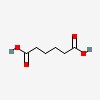 3D/inchi